

An intricate pattern of European wine classifications can enter into a stupor. Here’s another wrinkle on wrinkled in suspense the forehead.
The highest stage official Spanish wine classifications : Vino de Pago, as private Association Grandes Pagos de España (Great Pago Spain), is based on the idea of wine from a single vineyard – “one of the wine industry”. That’s where the similarities end and the confusion begins.
In 2003 Spain introduced a new official category of wine – Vino DO de Pago, crowned the top of the classification – above category, DOC Rioja and DOQ Priorat.
One of the consequences of this innovation was a ban on newly emerging households to use the word “pago” in their names. What, generally speaking, severely – it is the common word, which in Spanish basically means a plot of land or vineyard.
And “Vino de Pago” (Vino de Pago), and “Great Pago Spain” (GPdE, Grandes Pagos de Espana) put forward a number of requirements that you must meet to keep their membership. They are not mutually exclusive, but the intersection between them are rare:
There are 14 Vinos de Pago and 30 GPdE, while only 6 farms are included in both categories (early 2015).
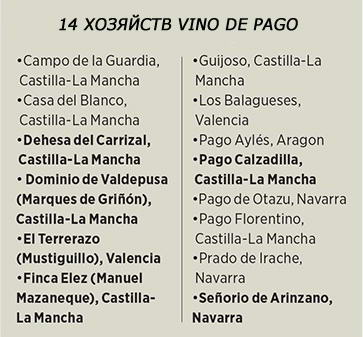
You can occasionally hear the claim that not all owners of the title “Vino de Pago” strictly adhere to the established rules for them.
There is a reproach in this category and that it is a thing in itself, driven by powerful producers, who for various reasons do not want to be associated with DO to which they belong geographically.
Another stumbling block is the fact that many (not all, but many) such farms make wine from international grape varieties or varieties that are not native to their region that does not fit into the concept of maximum reflection of the terroir.
Outside of the official classification
More fog suggests gaining weight, the manufacturers ‘ Association of the Great Pago españa – Grandes Pagos de Espana (GPdE), which appeared in 2000 as Grandes Pagos de Castilla, but which now include farms from the entire territory of the country.
The original intent of the 8 founding members were joining efforts to promote the wines of Castile-Leon and Castile-La Mancha. However, over time they wanted to join winemakers from other regions, so they changed the name, and the group began to expand.
The charges are heard GPdE is that it is, in fact, is an elite club of winemakers with a paid membership. The fee for joining it really is, as annual contributions. But the organization say that the money goes to Finance marketing and other activities aimed at implementing the objectives of the Association and this activity has the purpose of profit.
Whatever it was, but the list of its members such names as Mas Doix from Priorat, Vallegarcia of Castile and Bodega Mustiguillo Valencia.
“Pago” criteria status
In order to be called Vino de Pago, the specific winery must meet the unique criteria on climate and soils, to ensure that you are using only their own grapes and bottling wine on the farm. Although the last may be some legitimate exceptions that complicate the understanding.
Besides, to obtain the status of Vino de Pago, the economy should at least last 10 years to produce exceptional wine that is quite subjective.
Rules of inclusion in the list GPdE is not less vague. As in the case of Vino de Pago, the applicant must provide a comprehensive description of its vineyard, production and philosophy, plus a tasting pass assessment of the special Committee to confirm the quality. Also, you need the actual history of commercial success and critical acclaim – that too will agree, is very subjective.
The rapid development of the GPdE category is clearly ahead of the official classification. And no wonder: in the first you can get wineries of Cava, Bierzo, Somontano, Rioja, Toro, etc., and Vinos de Pago limited to just a few regions, which are dominated by the Castile-La Mancha. This situation is due to the fact that even though the class Vino de Pago and was approved at the state level, each region has to ratify it themselves, and it has made a few.
As the expert on Spanish wine magazine Decanter, the problem is lack of sense of value of their own region. “I’d say Vino de Pago stuck where local winemakers are not proud of their native appellation, for example, in Navarra, La Mancha and Valencia,’ he says. – Instead of having to work together to raise the level of their native region, producers and politicians prefer to create an unclear legal structure, does not involve neither the terroir nor the local traditions of winemaking”.
Obviously, both classes are United by the idea of promoting the wines of “one farm”, but GPdE, not being shackled with bureaucratic hurdles, has more opportunities for development.
Due to the circumstances described above, it is the class GPdE combines many of the stars of Spanish winemaking, but with a conspicuous lack of superstars, Vega Sicilia, Pingus and L’ermita, whose reputation is such that they have no need for this membership.
In fairness, the Association GPdE not asserting itself as a single list of the best wines of Spain. Although regularly voiced a collective vision and unified position.
With Vino de Pago all the more difficult
She seems too focused on a unique winery, working only on his grapes. But the positioning of this class as a greater level of traditional appellations with their centuries of history – a little discouraging. Especially that this category is limited to a few wine producing areas of Spain.
However, Tony Carrion from Bodega Mustiguillo, is a member of both groups – the estate of El Terrerazo (Vino de Pago + GPdE), and Finca Calvestra (GPdE) believes that each has its advantages: “Vino de Pago that we are not imposing strict rules DO, and GPdE allows you to more fully develop the idea Vino de Pago”.
Adolfo Hornos, General Manager and winemaker in Vallegarcia (member of the GPdE), also believes that, despite the confusion, the membership of both makes sense: “Vino de Pago means that you are unique, but at the same time you are given to yourself, assistance should not wait. That’s the advantage GPdE – strong enterprises manufacturers developed external relations. Within this group we also collaborate, share knowledge and ideas.”
To some extent, these systems have in common with other European wine organizations and classifications, such as Chianti Classico Gran Selezione in Italy or VDP in Germany, although don’t copy any of them.
The best wines of Spain..?
The modern concept of the Spanish “pago” in General, noble – especially in terms of higher requirements (at least on paper) to many processes in the vineyard and in the winery.
But the confusion with the implementation arose from the very beginning, when the creators Vino de Pago unceremoniously hoisted it to the top of all the Spanish classification. Considering how limited it is still the geography in this class, it becomes obvious political component.
The undoubted value of both groups in the number of strict quality requirements that must be followed to gain membership. I.e., the consumer is entitled to expect at least that buys high-quality product.
At the same time, no inscription DO Vino de Pago, or mark the Grandes Pagos de Espana does not guarantee that you buy the best we can, the winemakers of Spain.
Judge for yourself: Pingus is a wine “one household”, as Vega Sicilia Unico. And certainly Peter Sisseck and Pablo Alvarez are very meticulous in matters of winemaking. At the same time, neither one nor the other are not included in any of the groups. And for sure have something to say about Vino de Pago as the pinnacle of Spanish winemaking.