Champagne is a wine unique. To start with, when picking grapes for champagne technique is not used, the entire collection is a manual process to deliver the berries to the place of the press in perfect condition.
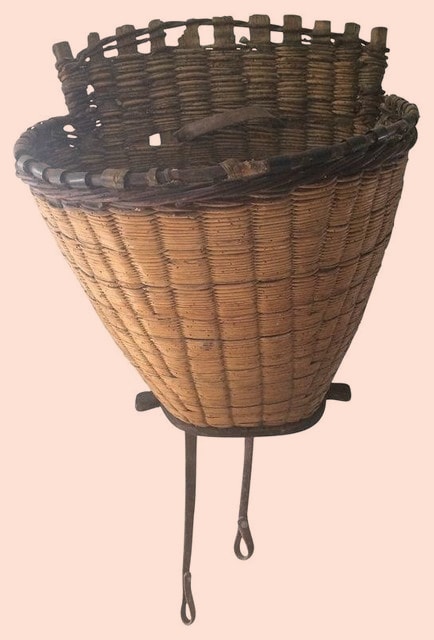
Regular large basket was replaced by a little scrip of basket so as not to crush the grapes to wear. To reduce the travel time of the grapes, arrange the points of its processing directly in the middle of the vineyard.
When the production of white champagne from black grapes Pinot Noir (this champagne is on the label Blanc de noirs – “Blanc de Noir”, i.e. “white from black”) you need to juice is not in contact with the dark skin of the berries, hence such gentle sensitivity.
Compaction should occur quickly and in such a way as to be sequentially and separately collect the juice. Hence, a special form of the traditional champagne presses: these grapes are poured on a large surface, but the layer thickness should be small to facilitate the movement of juice. Harvested grapes must be free of damage.
Compaction occurs according to strict rules. There are a total of 1 929 items for pressing, each of which must obtain a special work permit.
From 4,000 kg of grapes for champagne production can be used only 25.5 HL of wort, which is divided into two factions:
- cuvée (FR. cuvee) is the first 2050 l
- Ty (FR.taille) – the next 500 l
It is possible to compress further, but then get the wort that do not fit within the rules of the appellation of champagne. This so-called Rubezhnoe wine (FR. rebêche), which goes to distillation. Than longer the compression, the worse the quality.
The resulting mash is transported to the winery for future vinification for white wines the usual way.
At the end of winter, the cellar master conducts assemblage: it tastes of wine and mix them in such proportions to achieve a harmonious, characteristic of this brand of taste. If not champagne millesime (i.e. not from a single harvest of a particular year), the use of reserve wines from previous years. The champagne laws allow for the addition of a small amount of red wine in white to get a pink color tone (which is prohibited in all other parts of France).
Then begins the special production – the transformation of still wine into sparkling.
“Champagne method”
Real champagne is called champagne method – by secondary fermentation in the bottle.
The same method in relation to sparkling wines produced in champagne is not, is replaced by the term traditional method – méthode traditionnelle. It consists of the following.
The grapes are harvested, put under pressure, make the base wine – the usual still wine, rather sour, to eat is not useful. Then produce a blending of base wines, achieving the desired taste that meets the style of the manufacturer. Mix can as wines of different years, and the wine of a single harvest. The main idea of this mixing, which is called the assemblage to achieve consistency of taste, smoothing out annual fluctuations in the quality and characteristics of the crop. The resulting mixture is called the Cuvee (cuvee). The mixture obtained from selected base wines for special purposes, called a prestige Cuvee (cuvee prestige)
If the crop is outstanding, it is champagne made only from him, by putting the year on the bottle, and is called champagne millesime (synonym “vintage”).
Then the mixture of the base wine is bottled and add so-called the liqueur de tirage (liqueur de tirage) – wine with dissolved cane sugar and specially bred yeast strains. Bottle clogged temporary metal caps (crown cap, like beer), sometimes with the use of a plastic gasket bidule (bidule), which may take the form of a Cup to facilitate collection of the precipitate.
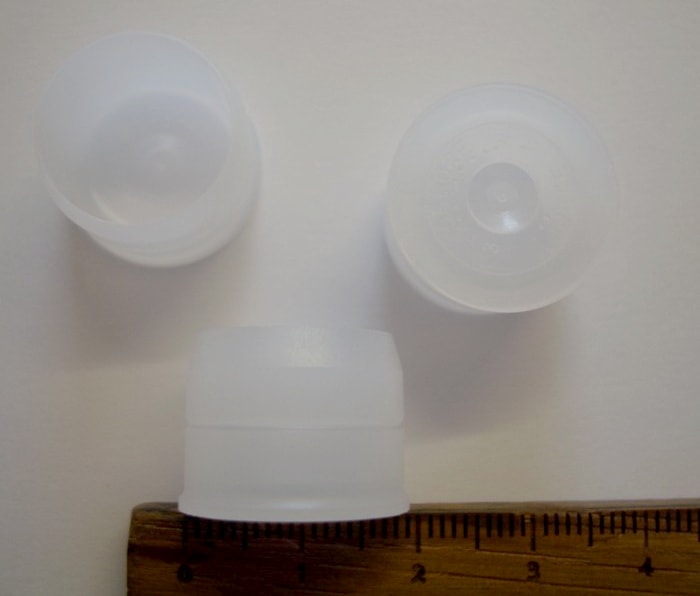
Option sealer (bidule) in the form of a Cup
Some (very few) producers carry out a secondary fermentation under natural cork temporary, arguing that its porous structure flows a little more oxygen, making the wine softer and the game of bubbles is thinner. In this case, the stopper on the bottle keeps clip called agraf (FR. agrafe):
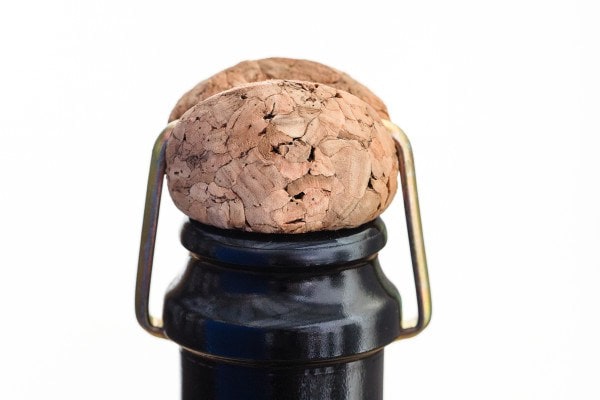
Agraf holds a temporary natural tube during secondary fermentation
The wine in the bottle again begins to wander, and because the bottle is tightly capped, the carbon dioxide dissolved in the wine, turning still wine into sparkling.
When the fermentation is over, the bottles remain in the cellar in a horizontal position on wooden racks (FR. sur latte) for aging on the lees of spent yeast (sur lie aging) and products of their autolysis (post-mortem decomposition). The longer aging on the lees, the more subtle and refined bouquet turns out. Legislative minimum in champagne is 12 months. aging on the lees of sparkling (plus three months after removal from the sludge), but in practice these terms are always more.
After such exposure the bottle upside down placed on a special stand to collect sediment in the neck.
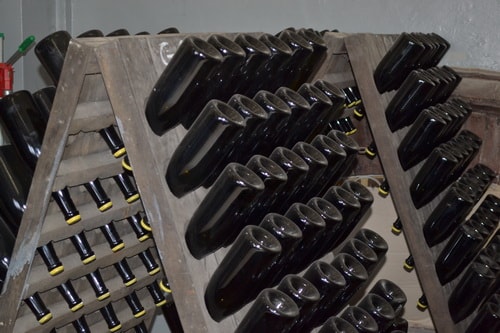
Music stand for manual riddling
Bottle regular povorachivat around its axis, increasing the angle of their landing in the holes of the stand, i.e., bottles are becoming more vertical position. The purpose of such manipulation is to collect all the sediment in the neck, preventing it from sticking to the walls of the bottle. This process is called remuage. For the first time the music stands for riddling was used by champagne house Veuve Clicquot.
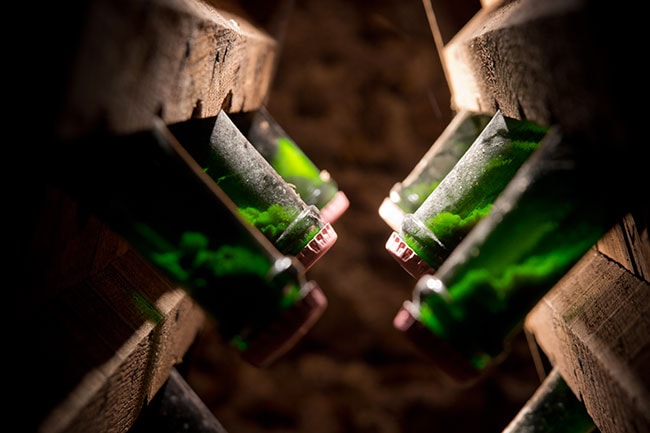
The sediment in the champagne bottle after the riddling
Many modern productions of the archaic wooden music stands gave way to modern europalets – automated wire mesh cubes that replace manual labor for the turning of the bottles. Introduction to the innovations of the industry required producers of cava from Catalonia.
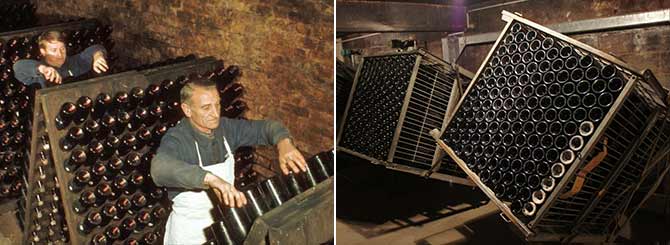
Automatic europalety replace the manual remuage
Assembled thus, the sediment is frozen, much of the cooling zone of the neck of the bottle, immersing it in brine or glycol. Then, the bottles already in the normal position – it’s a stiff with the sediment under the pressure of itself leaves the bottle. This sediment removal process is called disgorging (FR. dégorgeage).
After disgorging is carried out adding (for compensation of losses of wine while extracting the frozen sludge) and add the so-called combined with dose liqueur (liqueur de dosage, he expedition liqueur expedition liqueur d) containing dissolved in the same wine and sugar with a “secret additives” maker and close the permanent (natural cork) cork, held the bottle twisted wire muselet.
The pressure in the champagne bottle ready: 5-6 ATM.
Depending on the amount of sugar in the liqueur combined with dose turns the champagne a different degree of sweetness. If the sugar before the final capping is not added, then the champagne gets the inscription brut nature or zéro dosage. This, however, does not necessarily mean zero sugar because not all sugars subject to revision by the yeast. But the sweetness of these wines is the minimum of all possible options.