My mom once sent me a birthday card with the inscription: “Before you find a Prince you have to kiss a lot of frogs.” Well, dear readers, I just finished kissing frogs on your behalf. Fortunately, Prince I managed to find.
And not even one.
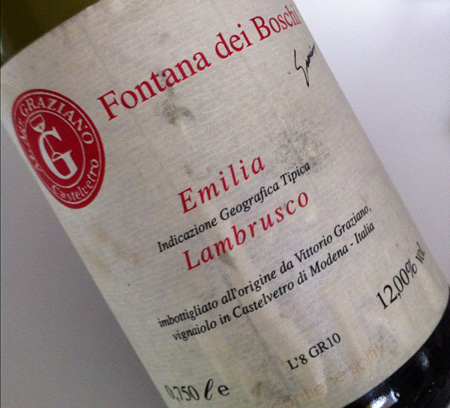
The princes in this story are real, true Lambrusco samples. And as frogs – other, industrial designs, manufactured to the extent that you do not even dreamed of. No, it’s quite a tolerable wine with good acidity, light tannins and a fairly frothy, some can even be called good – but definitely not outstanding.
While the first was outstanding. They lured me in Emilia-Romagna and its aromas of wild cherries and wild herbs. In this Lambrusco is something primal, something that makes you return to it again and again. Perhaps the fact that the method of production can be unpredictable. And maybe the fact that the yield of wine from the best samples at reasonable levels.
In General, the product yield for Lambrusco reaches huge values of up to 140 hectoliters per hectare (compare: the maximum permissible output for the base wines of Bordeaux – 55 HL / ha). “Are you kidding?” – I asked the export Manager at the local cooperative. “Of course – he answered completely seriously, is to keep such a low level is not always easy.” Powerful, irrigated vines planted on the plains in fertile soil, next to the pear trees and barley, often produce much more: for 200, and even 300 HL per hectare.
Received from them and then make a sparkling wine by the method of Sharma, interrupting the fermentation, when they are still a lot of residual sugar to balance the high acidity and astringent tannins. Sometimes using the classic method (Metodo Classico) – also known as “traditional” or “champagne method” – then the wine is softer, smooth, more elegant.
But most of all we are interested in Metodo Ancestrale – the so-called “method of the ancestors”. Here there is a place where surprises.
The wine is starting to sbravati vats – to the level of about 10-11% potential alcohol and then bottled, where it its final fermentation takes place another 1-2% and the residual sugar is at a level of about 8 g / l (or more if the winemaker fermentation is interrupted by cooling). After can be followed by remuage and disgorging, but not necessarily: some people prefer wine with “Tumanian”. If before pouring shake the bottle, not the past disgorging, the taste is noticeably different: less fruitiness and more “activities”, compared with wine, which gave a sediment sediment before bottling.
Vittorio Graziano says that for a long time he remained the only one to make Lambrusco by this method. Now it was followed by others, including large companies producing one or two names Lambrusco Metodo Ancestrale, although the output of wine at the “big brothers” is still much superior to his record in 46 HL / ha.
I do not want to belittle the virtues of a good Lambrusco by the method of Sharma – some of them are very good, and I do not guarantee that will distinguish them blindly from “crafting”. The point is that there are different levels of authenticity Lambrusco, and in the absence of sufficient information on the labels, which could rely in finding the best wines, I decided to start with the extremes of the craft and move back to normal. But normally I never returned. And here’s a few notes on the results.
The coming boom Lambrusco?
According to Vittorio Graziano, in the late 1960s – 1970s, the vineyards spread rot. Until that time, planting density was significantly higher: up to 10,000 vines per hectare. Now it’s like 3,000 or 2,000 or less thousands.
I guess Lambrusco today is on the threshold of new frontiers. The modest initiatives on the revival of authentic wines will develop into a serious movement, and in 10 years will be a special producers ‘ Association, perhaps even a special bottle and we will see the birth of a cult. And higher prices.
A variation from the hills – Lambrusco grasparossa (Lambrusco Grasparossa) – this wine is inky red, with purple foam and noticeable tannins.
Lambrusco Sorbara (Lambrusco Sorbara) – part of the representative, with bright strawberry color and flavor, less assertive, but is characteristic of all Lambrusco acidity.
In total there are 9 different types of grapes Lambrusco Salamino including (Salamino), Maestri (Maestri) and cellar (Marani). And also, not less than 5 different DOCов : Sorbara, Grasparossa di Castelvetro, Salamino di Santa Croce, Modena Modena Rosato and Rosso.
(See. the types of Lambrusco)
All this tells us is that Lambrusco us to drink and drink… And without all. Or as an aperitif. Especially Lambrusco Sorbara. And confident Grasparossa you can apply and for the main dish. Good Lambrusco with local food – it’s a song.
In the dry versions, the level of residual sugar 15 g / l, but the best examples of the taste will be quite dry (and the acidity must be something to balance).
Semi-dry wines have noticeable sweetness on the palate. Well amabile – frankly sweet.
Personally I am a supporter of dry. But sweetie likes…