
The lack of information about Prosecco leads to the fact that consumers are less and less concerned about the difference between Prosecco DOC and Prosecco DOCG

“We make our wine only from the best glera grapes – the official Prosecco varieties growing in our vineyards in Italy”, – stated in the manufacturer’s website is Cupcake Vineyards. On the pages of the portal of California, Livermore said about their wine Prosecco DOC, one of the most visible representatives of Prosecco in the U.S., which is equally easily found in Megamart, and in specialized grocery stores.
But when they write that their Prosecco “only from the best grapes glera”, we can only guess: whether it is the historical grape from the hills, which launched the popularity of this wine, or the foot of the valley in Treviso, or even from Friuli-Venice-Julia, where Prosecco is a relative newcomer.
Introducing in 2009, the category of the Prosecco DOCG, the consortium of Prosecco producers wanted to help consumers to distinguish high-quality wine (DOCG) from the ordinary (DOC). The usual Prosecco is produced from grapes grown in the bed of the valley, and the wine DOCG is a vine blessed slopes of the hills in the districts of Valdobbiadene (Valdobbiadene), Conegliano (Conegliano) and Asolo (Asolo).
Steep slopes, a favourable southern exposure, stony morainic subsoil and the breeze from the Adriatic create in the Conegliano-Valdobbiadene (Conegliano-Valdobbiadene Prosecco DOCG) and Asolo (Asolo Prosecco DOCG) the ideal conditions to create a fresh wine with lively acidity and distinctive minerality.
In the 1990s, when English speaking countries began the boom of Prosecco from Conegliano Valdobbiadene, more and more producers began to plant a variety glera in the bed of the valley, where the cost of harvest and winery work is much lower.
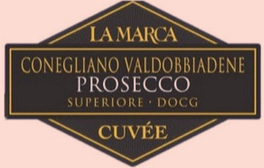
In the mid-2000s leading suppliers of Prosecco decided that it is not necessary. Their consortium proposed to create a new DOCG, which would include only the best site for vines of glera. And in exchange for the right to attribute prestigious “G” to my DOC, the area for the rest will be expanded to northeast and include the entire region of Friuli-Venezia Giulia, where sparkling wine from glera started to settle down as a new category of local wines.
According to previous years, roughly 70 million bottles are now produced annually within the DOCG and about 230 million under the enhanced DOC.
But, unfortunately, consumers still have little idea about the differences in the quality and origin of wines in two categories.
“I really don’t see someone really understand the difference between DOC and DOCG, and specifically requested one or the other, – the representative of a large purchaser of wine in California. And I really think that most do not know that there are different class of Prosecco, and even more so, what’s the difference”.
These observations echo in the respond on the East coast of the United States. The Owner Of Chambers St. Wines in Manhattan says: “Few of our customers are interested in the classification of Prosecco. I think very few Americans are aware of existing differences”.
In light of the growing volume of exports of Prosecco, amazing weak activity of the consortium of producers of wines classified as DOCG to inform consumers about differences in quality.
“It is evident the growing popularity of Prosecco as a whole, – says the Manager of purchase sparkling wines of Wine Country in California. – A couple of years ago I had to tell people that there is such a wine. Now all know – people come in and ask do they have”. But distinguish whether the buyers of wine DOC and DOCG? “No. Did it not look”.
“The interest from buyers has grown tremendously, and the number of suppliers offering us Prosecco on the implementation, over the past couple of years has almost doubled. And among them, I recently had to try quite banal and utterly stupid samples. So I think that a mass exit on the market is not good “brand” Prosecco”
In late 2013 I asked the President of the consortium, if they plan a media campaign in English language for informing consumers about the existing difference between the two appellations Prosecco. He said that such plans do not have.
Until recently, on the website of the consortium of producers of Prosecco all information for consumers has been reduced to banal and destructive informative sentence: “From 1 April 2010 to preserve this precious treasure created by man and nature, Conegliano Valdobbiadene Prosecco Superiore has become part of the premium Italian DOCG, where G means a guarantee of quality in every bottle”.
Fortunately, recently added a pdf file to English language details about the features of the Prosecco DOCG wines, though interspersed with meaningless lyrics, to find where the significant facts are quite difficult.
If the consortium will not pay enough attention to the active informing of the end user, the upscale wine DOCG risk of becoming unsustainable. That would be very sad.