You will be surprised how good can be ordinary wine (i.e. a simple class AOC Chablis), especially recent vintages.
I suspect that in a blind tasting many of the “just the wine” was not inferior to the CRUs. This is largely a consequence of high quality vintages of recent years.
In 2007 and 2008, even the badly located sites have got decent sun to ripen, making the role of the nuances of the soil and slopes was not as decisive as weak and in bad years, when every ray of sunshine for the local vines is critical.
In the same way as in the côte d’or, the vineyards of Chablis have a hierarchy of Grands CRUs, premiers CRUs and conventional (including Petit Chablis). But their ranking policies available to the public: the reasons why some and not other areas over time, moving from the rank and file in the CRU, not entirely clear.
In Chablis the exposition, it seems, means more than the soil. Kimmerijsky limestone, of course, very much appreciated, and gives the wine a refined clean – more than can give Portland limestone. But:
If you look carefully, you will find that the only significant difference for many parcels of Grand CRU from the ordinary phase – this is the exposition: here’s the right CRUs Vayon (Vaillons), and the slopes on the left – a simple village, i.e. ordinary Chablis.
Yes, there is a slight variation in the composition of the soil, but the main difference is that Vayon oriented to the South Southeast, and slopes across the road – no, and therefore, their exposure is not so good.
Most clearly seen on the example of Grand CRU and best parts the CRUs, such as Fourche (Fourchaume) and the montée de Tonnerre (Montee de Tonnerre). In other cases, the difference is not so obvious. And that’s one of the reasons that ordinary Chablis might also be of exceptional quality.
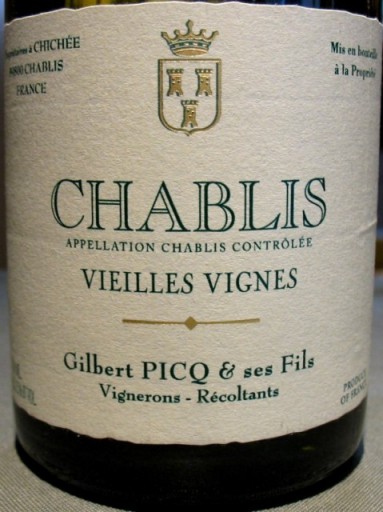
Another important factor is the age of the vines. Some households own parcels classified simply as Chablis, but with old vines, giving a concentrated wine with a strong personality.
This explains why some farms (not all) of the special cuvée “Vieille Vignes” (cuvee vieilles vignes – wine from old vines), produced in addition to their standard lineup of Chablis, have a real bright character.
The major expansion of plantings in Chablis was in the middle of the 1980s, so that even these vines are already much older than 20 years. They already lost young power, and their yields are already very committed to acceptable levels.
Global warming also played a role. Region, like the surroundings of Fontenay to the North of the town of Chablis, for a long time was considered exorbitant for grapes, and now here wheat and corn fields give way to high-quality vineyards.
No differences in conventional vinification Chablis and Grand CRU. If the côte d’or finest white wines roam and aged in oak, with a certain amount of new barrels, the most Chablis premiers CRUs, as usual Chablis (village), aged in stainless steel vats.
If there is use of oak, most in the form of old barrels – in order to careful oxidization (oxygen saturation) and not to impart oak tones. Chablis therefore any level of inherent transparency of the bouquet in which the purity of fruit notes rarely obscured the flavors and aromas of wood.
There is room to grow
And yet, traveling to vineyards, there is a feeling that these wines can be even better. Many growers still use herbicides, and the majority of vineyards used mechanized collection. Although some very responsible producers like Brocard and Pascal Bouchard switch part of their vineyards to organic farming, they are in a noticeable minority. And while the Grand CRU is practiced mostly by hand picking, in most of the vineyards have large yields and machine Assembly.
Of course, the engine charge can be justified. But it’s hard to resist the thought that if given the wines of Chablis as much attention and effort as to white wines of the côte d’or, their quality would be phenomenal.
Good lands, suitable clones, low yields, moderate use of new barrels and aging on the lees can create compelling rivals white Burgundy. One example of what regular vineyard Chablis AOC, in the right hands is a Chablis Billaud-Simon Villages
Chardonnay “no oak” is gaining popularity in California and Australia, but it is unlikely that they will ever match the energy and minerality of Chablis.
In conditions, when the French wine class of premiers CRUs and Grands CRUs many seem to be overpriced, ordinary Chablis gives you the opportunity to obtain an excellent wine for a very reasonable sum of money, attaching just a little effort, digging in the producers and vineyards.