Polishing the taste of various dishes and drinks, I have always used the usual “improvers”: salt, pepper, herbs, spices, lemon juice, a popular seasoning. Why it never occurred to me to use is water. Because water has no taste, she’s not appeared – it dilutes.
But a couple of months ago, the London bartender friend told me that light cocktails can be more aromatic than strong drink. This observation pushed me to experiment with dilution water, wine and other beverages. And this month one Barista showed me that coffee and you can prepare more flavorful using less beans and more water.
As it turned out, it’s true: the water, in fact, a useful catalyst for the bouquet – exactly because it dilutes other ingredients, thereby able to improve the overall flavor balance.
It is no secret that the alcohol in the drink helps to convey to us its bouquet. At the same time, when the alcohol content exceeds 12% of the volume of the drink, we begin to feel his own irritating effect on our receptors. Spirits like whiskey and gin, with strength of 40 degrees or more, can be quite hot.
Admirers and experts of whiskey pay great attention to the evaluation of the “nose” of the drink, appreciating its fragrance in properly chosen glass. And these experts it is well known that diluted when tasting the whisky with water almost half, it is possible to significantly reduce the burning effect of alcohol and an amazing way to reveal its aroma.
How does the water manage to mute some feelings, strengthening others?
Alcohol molecules, and the molecules of aromatic compounds – volatile. Ie they evaporate from the surface of the food and drink and in the air fall on our receptors deep in the sinuses.
Aromatic molecules more chemically similar to alcohol molecules than water, so they tend to “cling” to alcohol. And therefore more actively evaporate from the drink that has less alcohol, which is holding them.
This means that the stronger the drink, the better it “holds” your aromatics, and the less aroma it releases into the air. Add water and burning effect of alcohol will decrease, and the evaporation of the flavors will intensify.
This explains why cocktails type Manhattan (vermouth and whiskey) may be less fragrant than soft options, and as said by many bartenders.
Audrey Saunders of new York’s Pegu Club, which led me to think about creating a “drinks on the contrary,” as she called them: they are spirits playing a supporting role in relation to vermouth and other alcoholic ingredients. Her “Madeira Martinez” includes 1 part gin (40% ALC.) and 2 parts Madeira (20% ALC.), which together have a fortress in the region of 30% – until further diluted with ice. “Intro to Aperol” from the two parts 11% table wine and one part gin, has about 20% of the fortress. According to Audrey, in drinks of this kind the main idea is to accentuate the aromatics of the weaker ingredients.
To see what are drinks without scalding effect of ethanol, I diluted a few samples of simple water in a ratio of 3-to-1, reducing their fortress to the level of low-alcohol wine. They all remained noticeably fragrant, a couple of English gins – and all are exceptional. Adding a little lemon juice and sugar syrup, I got a strange but pleasant drink, a sort of “Aqua-gene.”
Hard wine (with a strength of more than 14% vol.) often described as “sharp” and “unbalanced”.
The chemists who organoleptical, found that high alcohol content accentuates bitterness in wine, reduces its perceived acidity and inhibits the release of most of the aromatic compound: in particular, fruit and floral aromas.
T. O. is mainly formed of wood – plant (herbal) bouquet.
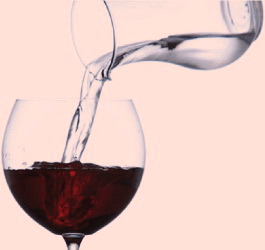
About the modern experiments with the dilution of the wine I have not heard, although it is known that it was practiced by the ancient Greeks. And I decided to experiment with a California Zinfandel fortress 14,9% vol., diluting it with water to about 12%
Have undiluted wine taste was sharp, a jam, a bit of sulfur. A watered-down version that was easier in all respects, but still very flavorful, more acidic, less sour and fruit rather than jam.
Although competition for a full 12-degree wine from less sugary (potentially less alcoholic) berries diluted 15-degree wine to have failed, it turned out to be surprisingly pleasant and in my opinion, more suitable for summer evenings than the intense original. I finished off the remains alternating in the throat of both, enjoying the contrast.
Additional water is in coffee. I learned this from James Hoffman – winner of the world Barista competition 2007 whose passion for fragrance led him astray from espresso to filter coffee, the bouquet is less concentrated, but more versatile.
Mr. Hoffman owns the company, which is engaged in roasting coffee. In a London coffee bars, he held a mini-course dedicated to the brewed and filtered coffee. They were picked up by contrasting varieties, cooked them in different ways and discussed with visitors to the advantages of ingredients, methods of cooking and flavors.
Recently I had the opportunity to participate in a tasting of coffees from Kenya, Ethiopia and Guatemala. Roasting all had weak – to the peculiarities of the varieties are not lost in the more intense but more generic taste that comes from roasted. Each Cup of beverage was significantly less concentrated than I usually do myself, but at the same time – delicious and more distinctive.
Mr. Hoffman explains: the standards of the fortress brewed coffee vary greatly. He is focused on the level of extraction in 1.5% of dry matter. The constancy of the fortress he achieves by using of high-precision heater and digital controller, metering the amount of water accurate to one gram.
“Catching grams may seem silly,” he says, ” but it greatly affects the taste.” Plusminus a tablespoon of water can change the amount of the extracted substances on quite perceive value.
Equally important is the way in which extraction occurs. Says Hoffman, the taste of strong coffee often improve by increasing the number of grains per serving while reducing the time and temperature of cooking, which allows to obtain grain only easily removable part of the flavor (taste). The result is an intense but simple bouquet. Hoffman himself the advocate of a more complete extraction with a smaller quantity of high quality light roast coffee – in this case, the grain gives the full range of their flavors and aromas.
“When I drink coffee, says Hoffman – I’m concerned about the purity of the drink, i.e. its distinctive, characteristic, interesting bouquet.” And indeed, the weakness of the prepared coffee allows to reveal the individuality of different varieties, and the drink in the Cup cools the flavor changes, while remaining pleasant to the taste even at room temperature. “I know of no other beverage that would change so much as how you take it,” says Hoffman.
I brought home a little prepared by Mr. Hoffman Ethiopian coffee Yirgacheffe that love for its unusual blueberry aroma. And with a Refractometer (a device that measures the solute) compared with those who have prepared myself. My sample turned out to be 2.2 percent coffee the dissolved dry matter.
When I downgraded fortress to the recommended by Hoffman 1.5 percent (taking up a third less ground coffee for the same servings: about 12 g per 180 g of water), the fruity flavors are much more noticeable, and the bunch in General – lively and brighter. “Purity” – as they called it, Mr. Hoffman is really the appropriate term to describe the overall impression.
So now I’m making coffee with plenty of water, and I get a lot more cups of the previous number of batches of grain.
If you want to check focus with dilution, you can do without a Refractometer. But the use of measuring instruments, it is recommended to at least roughly adhere to the “Golden ratio” of Mr. Hoffman. If you are used to brewing coffee from expensive beans – try to measure out the water and coffee in its formula.
Or one evening, poured myself a glass of wine or whiskey and add a little water. And you will find that the beverage in the glass will not diluted, but rather will be revealed and show their best side.