

Pinotage (Pinotage) – the flagship red variety of South Africa. Almost nowhere else is grown. Gives a wide range of wines: from vague canteens to rich concentrated samples with a bouquet of red fruits, spice, leather and chocolate.
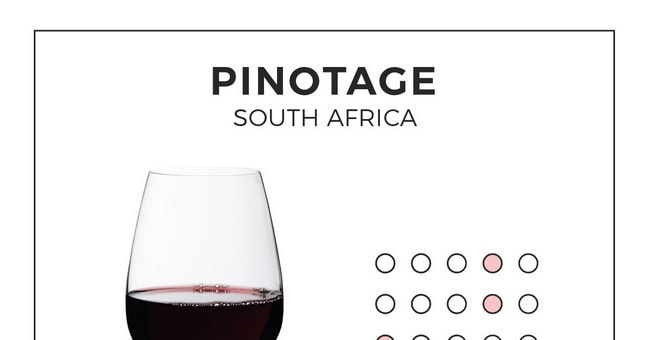
Throughout its history, the Pinotage has repeatedly compromised itself failed experiments, but today manufacturers South Africa in an obvious way trying to improve its image, using a thoughtful approach to the cultivation of grapes and vinification techniques.
Pinotage is a cross between Pinot Noir and Cinsault, first produced in 1925 by Professor Abraham Perelom (South Africa).
The word Pinotage – hybrid also: Pino + the Hermitage (in South Africa called Senso).
Abraham Perold was the first Professor of viticulture at the Stellenbosch University, and his goal was the creation of the wine varieties – refined, as Prince of Burgundy Pinot Noir and fertile as Senso. Apparently. Since no explanation for their choice of candidates for crossbreeding Professor left. The result was far from the intended image: grapes turned out very dark skin, and the wine from it is a dense and tannic.
So, the first vines of this cross planted in the garden of Professor Perold, was soon abandoned. And only after a few years, another researcher grafted them onto disease-resistant roots, and in 1943 he obtained the first commercial harvest. The berries ripen early, easily picking up large amounts of sugar, and the vines looked healthy and strong.
Pinotage is a hardy, prolific variety, but susceptible to some viral infections and can be very picky and capricious terroir in the winery.
The best wines from Bush vines – the system of conducting the vine, popular in the South of France, home of the Senso.
Pinotage loves the place brighter, but if the end of the vegetation period becomes too hot, the berries can develop unpleasant notes of nail Polish and burnt rubber. Need a very responsible approach to the process of fermentation: there is also at elevated temperatures is easy to appear the acetone aroma.
History also played a role in the fate of the bumpy variety. Throughout the 20th century, national wine enterprises (headed by a South African Cooperative Association of Winemakers, KWV) favored quantity over quality. Prone to high yields Pinotage generously gave nondescript wine that by 1980, has naturally reduced his popularity to a minimum.
Lucky for steels sanctions during apartheid and the growth of the demand in the 1990s. Then trends in the wine industry began to shift the focus towards quality. In 1995 was founded the Association of Pinotage – a group of producers that have joined together to promote and develop varieties.
Well made wine from Pinotage demonstrate a wide range of styles, from easy-drinking table wines to rich samples with potential for aging.
In Stellenbosch – the first landing – Pinotage is often blended with Cabernet Sauvignon and Shiraz to create superior blends for wines of above average.
Outside South Africa, Pinotage was not successful. In small quantities it can be found in New Zealand, particularly in Hawkes Bay and Auckland. And a little in Zimbabwe, California and Israel.
Gastronomy to wine from Pinotage:
- Spicy pepperoni pizza
- Meat dishes teriyaki
- Oxtail stew