Merlot (Merlot) is one of nine international varieties, and the second most common in the world red wine grape variety. The wine from it in every country, to claim their ambitions in the wine industry.
Synonyms varieties: Alicante Noir (Alicante noir), Tribute (Crabutet), Langon (Langon), Picard (Picard), Vidal (Vidal).
Merlot is originally from Bordeaux. Its name is translated from Occitan (the old language of southern France) as a “young Blackbird” – maybe because of the beautiful blue-black color of the vine, and maybe – for the love of these birds to eat its berries.
In France, Merlot is one of the top three red varieties with the largest area of vineyards (competing with Grenache and Carignan). And in its homeland in Bordeaux along with Cabernet Sauvignon and Cabernet franc is a so-called “Bordeaux blend” is a classic blend of three varieties, the most common in the production of “the clarets” – dry red Bordeaux wines (and wines that echo the style of classic Bordeaux: the clarets Spain, New Zealand, Germany). The term “Bordeaux blend” is exclusively literary and informational, on the labels it is not found.
Studies of the genetics of Merlot talking about his close relationship with Cabernet franc and Cabernet Sauvignon. Carmenere, is historically a part of the “enlarged” Bordeaux blend, too, is a close relative of Merlot and a long time was taken for him by many winemakers of Chile.
Merlot experienced a rise in popularity in the 1990s as consumers suddenly discovered the ability to enjoy the bouquet that rivals Cabernet, wine with less tannins and a much more mild flavor.
After the interest of consumers was followed by a wave of new plantings of Merlot, often on soils and in areas absolutely not suitable for this class. As a result, the market is sparse indistinct poured the wine from young vines with high yield and weed-herbaceous Merlot from unripe grapes. Many of these misunderstandings abundantly cabriales aged in oak in an attempt to hide the shortcomings protruding.
At the same time, a number of manufacturers of wine from the Cabernet began to collect the grapes more Mature and more carefully monitor the level of tannins during the production and aging of their wines. As a result, growing interest has become less dramatic but still striking young wines from Cabernet and falling interest compromised Merlot.
It is worth to mention such a curiosity, as the “Kaberle” – open Italian agronomist Remigio Bordin (Remigio Bordini) a hybrid of Merlot and Cabernet. The second label for this wine – Carnesale (Carnasciale), the name of the winery.
This mythical hybrid exists in one tiny estate in Tuscany and is produced only in magnums (1.5 l) with the label “Il Caberlot”.
Since its first vintage in 1988, Kaberle because of its rarity and quality, entered the ranks of the unique samples of wine in Europe, having become almost cult in the ocean.
Features Merlot
Merlot berries are large, with relatively thin skin and a less intense color compared to Cabernet. So the wine less tannic. Also compared to Cabernet, Merlot have a higher sugar content and lower content of malic acid.
Merlot early-ripening variety, and sometimes, he saves the winemaker in a cold year, or if the yields of other varieties are under threat because of the rains.
The flavors of Merlot
In young wine from Merlot is dominated by aromas of berries (BlackBerry, cherry, raspberry), violets, and wild plums or plum jam. Some find in it notes of cocoa and coffee.
With age, the flavors of Fig, chocolate, hints of spice (black pepper), and later leather and truffle (mushroom).
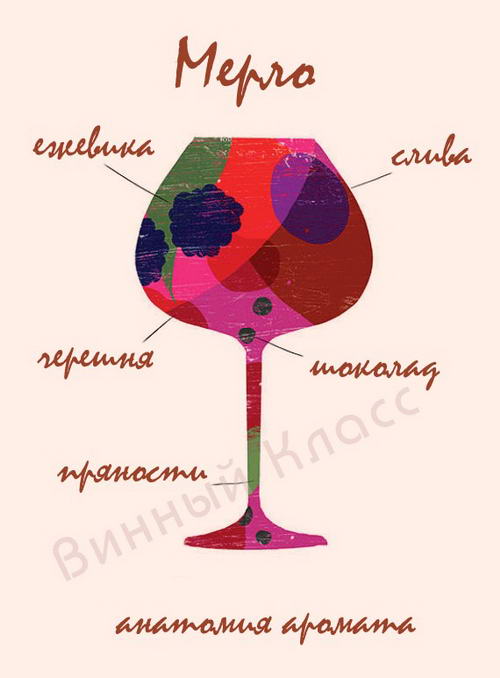
There is a difference in the aroma of Merlot from regions with different climate.
In hot countries the bouquet is powerful, aromas are more spicy, more will feel the alcohol. In cool climates the aroma will be more “green” and flowers, and alcohol will be less.
Wine from Merlot
The wine from Merlot is the best option for beginners is to discover red wine. This variety is not as demanding of endurance as walking with him hand in hand Cabernet Sauvignon. Merlot Matures faster, so you can open it young, and it is soft, rounded and “beverage”, in the language of a sommelier.
In General, the wine from Merlot is probably the wine with a certain “structure” than a kind of special taste. The experience is remembered more organoleptical than flavour: soft, rounded, easy-drinking are the most characteristic description of wines from Merlot.
Due to the large size of the berries and the small relative weight of the rind and seeds, the wine of Merlot has less tannins (substances that knit mouth), so at a young age it is not as tart, though, and has quite a rich color and flavor. Because of this, a glass of Merlot is an example of the balance of bouquet and understandable unsophisticated porebiteley, which, however, is already looking for red wine some “history”. For the same reason, Merlot is not as popular among the “advanced” experts.
However, Merlot is lovely and sometimes indispensable in blends. It is used to soften wines from more tannic varieties such as Cabernet Sauvignon (in the Medoc) and Malbec (in Cahors). It also applies to vintages of cold years to balance the sharpness is not quite ripe grapes and to make wine more usable at a young age.
By the way: if you watched the movie “sideways” (2004), you probably remember despising Merlot hero, a fan of Pinot Noir – and its categorical rejection of this wine. The film is seriously marred the reputation of Merlot, and completely uncalled for. I want to say in his defence, that the true wine connoisseurs would never say a bad word about this variety, even if you prefer something else. And here’s a fact: the world’s most expensive red wine – Pétrus – do almost exclusively from the Merlot!
Thanks to its smooth and calm character, Merlot is often used in blends to soften the more tannic varieties, and also to balance the aggressive young wines.