“Ruinart” (Ruinart)
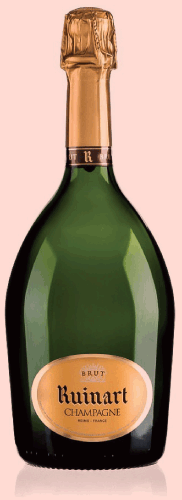
Ruinart – the oldest champagne houses.
Now included in the holding company LVMH (Louis Vuitton – Moët Hennessy)
Manufacturina founded by Nicolas Ruinart in 1729, the first champagne especially for the production of sparkling wines; and, in exactly, when the French have been allowed to export wine in bottles (before 1728 – only in barrels). Initially, the wines produced were intended for gifts to key customers, textile, Nicolas Ruiner – so it’s champagne was released on the European market. However, wine was such a success that since 1735 Nicolas Ruinart left the factory and is fully focused on the production of champagne.
In 1768, Claude Ruinart (son of Nicolas) bought for their cellars 8 kilometres Gallic chalk quarries, the ancient maze to a depth of 38 meters under the Reims, recognized in 1931, a historical monument of France. These quarries are still used for aging champagne Ruinart.
Of the prestige cuvée of the house of Ruinart in 1959 was released Blanc de Blancs “Dom Ruinart” in honor of the uncle of the founder of the champagne house – monk’s House of Thierry Ruiner, “infecting” his nephew Nicolas love of champagne.
Produced today, “Dom Ruinart Blanc de Blancs Millesime Brut” (Dom Ruinart Blanc de Blancs Millesime Brut) is made exclusively from Chardonnay from the Grand CRU vineyards and aged for at least 10 years.
Chardonnay is the main variety in the production of champagne Ruinart.
Kristall (Cristal)
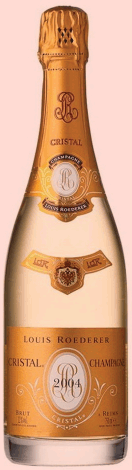
“Crystal” (“Cristal”, if you stick a French accent) is a brand of champagne produced by the house of Louis Roederer (Louis Roederer) of Pinot Noir (60%) and Chardonnay (40%) with a mandatory six-year aging on the lees.
Champagne “Crystal” is bottled in a crystal bottle with a gold label, which is wrapped in UV-impermeable film (as crystal, unlike glass, is conductive is detrimental to wine, ultraviolet).
“Cristal” was created in 1876 especially for the Russian Emperor Alexander II. This champagne was selected the best Cuvee (cuvée) of the house Louis Roederer, which was atypical for champagne producers. This practice subsequently received the name of “cuvée prestige” (prestige cuvée).
The legend says that a crystal bottle with a flat bottom was dictated by the fear of our Emperor to be poisoned during the “Dinner of the three emperors”, which was first presented this champagne. Crystal clear bottle and no bends DNA supposedly could detect poisons that could be added to the beverage ill-wishers.
However, if you consider that “Crystal” was one of the eight great wines to the menu of the dinner (including sherry and Madeira), then there are doubts about the historicity of this version. On the site of the house of Roederer it is also not mentioned. Anyway, champagne “Crystal” – the exclusive and among of champagne in General, and for the house of Roederer in particular. In a free market it entered only in 1945.
“The moët and Chandon” (Moët & Chandon)
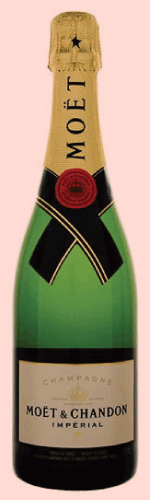
The moët-Chandon – largest champagne producer.
The house founded in 1743 by Claude Moët as Moet et Cie , and now is a holding company of luxury brands LVMH (Louis Vuitton – Moët Hennessy). The name Moët is of Dutch origin and is pronounced “moët”. In 1832, the management of the champagne house divided Victor moët (Victor Moët direct descendant of the founder) and brother-in-law retired Jean Remy Moët – Pierre-Gabriel Chandon de Briailles. From that moment the champagne house became known as the “moët and Chandon”.
For most of its history, that champagne went hand in hand with the Royal families of Europe: from the iconic location of Napoleon Bonaparte (a former friend of the family) to the recognition of “on the other side” – the English king Edward VII and Russian Tsar Nicholas II.
In the late 18th century the house was purchased, the vineyards of the famous Abbey of Avila (Hautvillers), which once worked for the legendary Dom Perignon.
In 1973 was founded Domaine Chandon (Domaine Chandon) – a branch of the champagne house in California (in NAPA valley). In 1986, the eponymous compartment (>Domaine Chandon) began work in Australia.
Since 1842 this champagne house released more than 70 vintages.
“Dom Perignon” (Dom Pérignon)
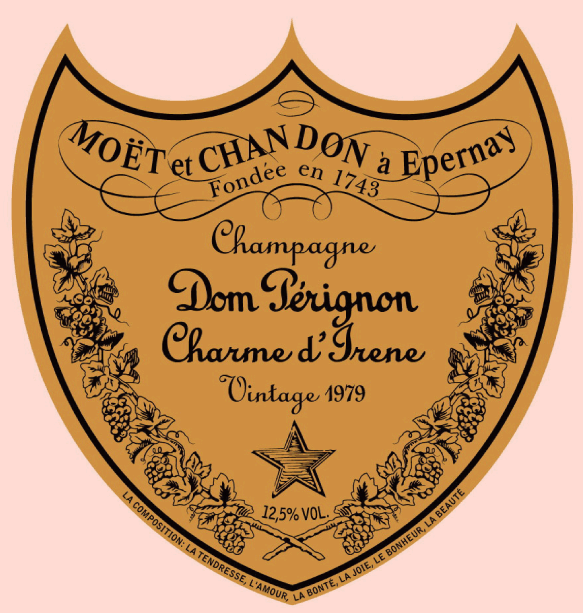
Vintage (and only vintage) champagne produced by the house, “moët-Chandon” in 1936 (this year, the market was released vintage of 1921).
First class champagne “prestige Cuvee” (prestige cuvée), released on the open market. The first ever was “Crystal”, but in the open market, he came later.
Champagne is named, of course, after the legendary Benedictine monk Pierre Perignon, who made a huge contribution to the development of the champagne wine. The vineyards of the Abbey, which “raise” the Dom Perignon now owned by the champagne house of “moët-Chandon”
1961 vintage was on the tables during the wedding of Lady Di and Prince Charles in 1981.
This champagne is made only from Pinot Noir and Chardonnay, in almost equal proportions (with the exception of certain vintages).
“Veuve Clicquot” (Veuve Clicquot Ponsardin)
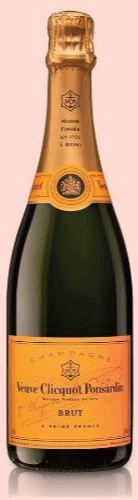
“The widow Clicquot” is the second largest production (after “moët and Chandon”) champagne house, founded in 1772, with headquarters in Reims.
Now is a holding company of luxury brands LVMH (Louis Vuitton – Moët Hennessy). But during the time of Napoleon, Jean-Remy moët, a former personal friend of the Emperor, was her main rival in the market of champagne.
The founder of the house was Philippe Clicquot Muiron, whose son married Barbe-Nicole Ponsardin, who at 27 years of age became a widow Clicquot, took control of the family company engaged in banking, trade fabrics and production of champagne.
Veuve Clicquot became the first woman at the head of the champagne house and one of the first women entrepreneurs in France. Her husband, before 30 years died of a fever, laid a good Foundation for the future of business, Madame Clicquot. As we already know, is in the production of champagne focused family business Clicquot under the leadership of the widow. Under her leadership, has grown into a thriving, innovative (as we would say) production.
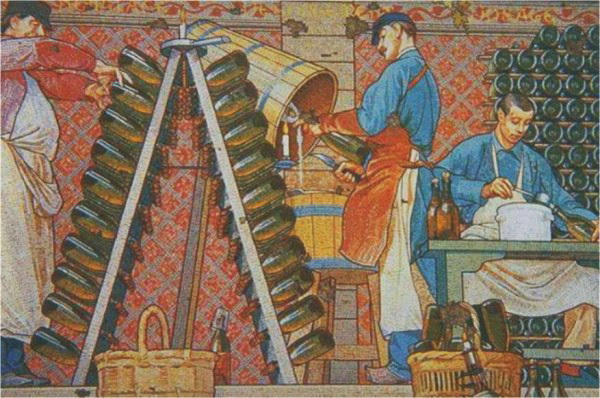
Madame Clicquot was truly resourceful woman and a talented entrepreneur. Modern champagne owes much to the widow Clicquot. Among the developments, released through Veuve Clicquot, the most important such things as muzzle and riddling (in the picture).
In Russia Veuve Clicquot “infiltrated” before the war of 1812, and during the Napoleonic wars, the champagne of the widow Clicquot was the one to break the blockade and went to the tables of Russian nobility, thanks to the foresight of its attorney – Mr. Louis Bon: his ability to negotiate, and of course bribes. And later, when Russian officers broke into the cellars of Veuve Clicquot, she uttered her famous phrase: “Let him drink, – will pay the whole of Russia”. Then there and the way to open champagne with a sword.
The defeat of Napoleon was Madame Clicquot on hand, because it deprived the most influential patron of its main competitor – “house of moët” (without “Chandon”). And hardly had the ink dried on the abdication of Napoleon from the throne, the party bottles of Veuve Clicquot under the Dutch flag (so as not to run into trouble) made their way to Konigsberg.
“Comet” The Widow Clicquot
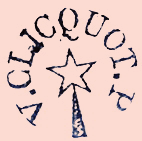
After a series of unsuccessful vintages of the early 19th century, 1811 was the year of the French winemakers turning point.
For Brandy this year in General is considered to be one of the best in history, and a bottle of Château d’yquem 1811, opened in 1996, received the maximum 100 points from Robert Parker (one of the most recognized wine critics).
“Great comet” of 1811, which was visible to the naked eye nearly 260 days, was interpreted as a sign and symbol of the great harvest. “Veuve Clicquot” has released his Cuvée de la Comète , which is called the pioneer of “modern” champagne as the widow Clicquot invented the riddling method (collection of sediment in the bottle of champagne for its removal) allowed to make a revolutionary in transparency and purity of taste of the champagne as we know it now.
In July 2010 a group of Finnish divers found at the bottom of the Baltic sea near the island of öland remains of the ship with a cargo of 168 champagne bottles the second quarter of the 19th century. Most of them were champagne house Juglar (now Jacquesson & Fils ) and several nevintazhnoe champagne “Veuve Clicquot” in the beginning of the 1830s years. today it is the oldest champagne.
Since 1987, the champagne house “Veuve Clicquot” is part of the LVMH Empire and controlling Cloudy Bay Vineyards (New Zealand, Marlborough)