

“Illness tube” – one of the worst enemies of wine. Exposed wines sealed with natural cork. The source of the problem (as a rule) the compound 2,4,6–trichloranisole (THA). A wine with a tainted cork – with lesser or greater intensity – gives a crude mold, cardboard, wet newspaper. In very low concentrations cortical defect drowns out the aromatics of the wine, making it “flat”.
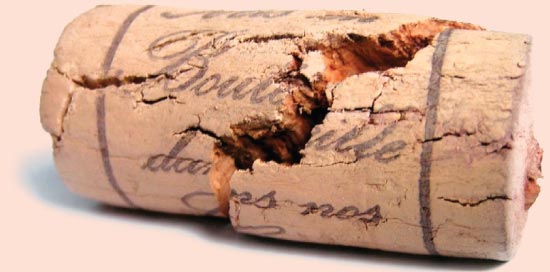
In an attempt to avoid this trouble, the natural wine replace the cork alternatives such as screw cap and plastic corks.
- Cm. The main types of traffic
A recent study conducted by a group of Japanese scientists, sheds light on the mechanism of action of THA on our sense of smell. The obtained results may help in the prevention of “cork disease”.
As found by Professor Hiroko Takeuchi with his colleagues, trichloranisole block number of olfactory channels (channels of perception of flavor). As a result of this blocking gives us a sense of what we call smell of trichloranisole – “defect in the tube”. But actually, it’s not that it is THA smell bad, and that he gives us to experience the flavors of the wine. And, therefore, distorts his taste (after all, the lion’s share taste impressions we get from fragrances).
“As follows from their report on the molecular and cellular levels, the compound responsible for the formation of this fragrance, does not cause excitation in the cell; it inhibits its activity,” explains Dr. Paul Breslin, Professor of Rutgers University (USA). “This is a new and very interesting observation.”
Professor Takeuchi had expected trichloranisole will excite the cells of the olfactory receptors. “We were surprised to discover that THA actually suppresses the signal impulses in the cells of the olfactory receptors,” she writes in her article.
To explore this phenomenon, the researchers isolated individual receptor cells of newt, which is three times larger than human. Subjecting them to the effects of THA, the researchers found that even in very small doses, this substance blocks the cyclic nucleotide-controlled channels of the cell membrane, causing the brain does not receive a particular set of signals from these cells. “Apparently, even a single molecule of trichloranisole having the simultaneous impact of many such channels,” said Takeuchi, in an interview with Wine Spectator magazine.
The next stage of the study was a blind tasting of red and white wines contaminated with a small amount THA, with the participation of non-professional tasters. Participants in the experiment caught the musty tone THA at concentrations of 2-4 parts per million. “Even from the point of view of pharmacology, THA, probably one of the strongest connections in the world,” said Takeuchi.
But how did the blockade of certain cellular channels creates a characteristic and discernible flavor? “Perhaps the researchers – people just have receptors that are sensitive to THA, which is absent in newts”. And maybe, the suppression of cell channels generates a signal which is interpreted by the brain as smell.
Paul Breslin makes the assumption that the organism in an evolutionary way to come to such a perception THA, because either way is a warning that a food or drink can be damaged.
Trichloranisole may be present in a wide range of food products: mineral water, apples, eggs, shrimp, banana peel. And on food packages.
The study can provide clues to the control of extraneous odors, which are relevant for the winemakers, and producers of food. The conviction Takeuchi, it opens opportunities for inventions of new substances, masking odors, as well as inhibitors of cellular channels for use in anesthesia and pain relief.
Dr. Breslin, however, notes that having dealt with THA at the level of olfactory receptors, we may encounter difficulties in its study when it inhibits the subpopulation of neurons. In addition, the effect THA at such small concentrations, greatly complicates any measurements. “In this case, the human nose is far ahead of the instrumental capabilities of our laboratories,” he adds.
Source: winespectator.com