Another study sheds a portion of light on the mysterious nature of champagne.
And once again confirms the great role of the right glass.
A group of scientists from the University of Reims, set out to discover the secrets of bubbles in champagne and find out why some glasses of champagne turns into a dull mediocrity, while others are forced to beat a fountain over the edge.
Gerard, 41-year-old head of the group, confident that they were able to open things hitherto unknown. Don’t want to upset Gerard, who opened in the laboratory what many fans of champagne has long been known on the domestic level – the work his team did a interesting.
What they found out?
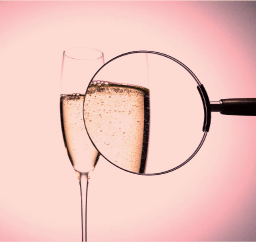
One bottle of champagne locked 10 million bubbles. Reaching the surface of the wine, these bubbles burst (a phenomenon called the “Worthington jet”). Scientists captured the process on camera, shooting 5000 frames per second.
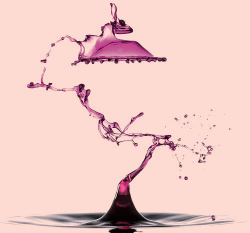
In a series of high-speed shots it is visible as the bubble rises to the surface and bursts, creating her micro-crater. Stagepas, this crater is spewing a stream of champagne, which shatters into fine droplets, rising to a height of 10 cm from the surface.
With the help of the mass spectrometer ultra-high resolution, the researchers analyzed the chemical structure of the samples, and found that champagne bubbles filled with “surface-active” molecules, among them hundreds of aromatic, creating a cloud of fragrance over a glass of champagne.
Scientists also figured out why streams of champagne bubbles, poetically called “pearl threads”, rise from certain points of the glass. This is due to the contact with the walls of the glass microscopic lint from kitchen towels by rubbing and other random particles entering the glass from the surrounding space. Molecules of carbon dioxide going into these microparticles and coalesce and form the bubbles.
The glasses washed in the dishwasher, where they were air dried in position upside down can be so clean that the bubbles in them will be negligible.
Leading manufacturers of wine glassware began to use laser to marking a border of micro-defects on the bottom of champagne glasses, to provide a slender beautiful stream of small bubbles. Lovers of champagne can help yourself by making a few scratches in your glass. But do not overdo it – experts warn – not to be harsh degassing – too a mass Exodus of bubbles.
Research group, Reims scientists, they think, put an end to the longtime dispute over the correct form of the champagne glass. World long tormented by the question: to drink or champagne “flute”, a tall narrow glass on a long stalk or “kremenek” – wide shallow bowls, repeating, according to popular legend, the shape of the breast of Marie-Antoinette.
Gas chromatography shows that the “Cremant” champagne loses its carbon dioxide at least a third faster than a “flute”. So if you don’t drink it a third faster, you risk to lose the wonderful bubbles.
By the way, to drink champagne from plastic cups (omitting other aspects) – also a good idea. The plastic surface is hydrophobic, i.e. repels liquids. The bubbles cling to the plastic walls due to the effect of capillarity and form large ugly bubbles.
This study was published in the publications aimed at physicians working with liquids and professionals of the beverage industry, working with beer, sparkling wines and soda.
In the champagne region, this study adopted the winemakers to calibrate the parameters of the secondary bottle fermentation in the production of champagne.
“The easiest way to achieve a beautiful bubbles is to reduce the content of dissolved carbon dioxide in champagne. And it depends on the amount of sugar,” says the head of the group.
Traditionally, to start a secondary fermentation in champagne were added 24 grams of sugar per liter of wine. Now the trend is to reduce this provision to 18 grams per liter – minimum allowable by the laws of the appellation.
Lovers of sparkling like the tiny bubbles – probably because they are associated with vintage champagne.
And researchers were suddenly faced with the criticism of traditionalists who claim that such a scientific approach kills the mythical aura that surrounds champagne. After all, the product of sparkling wine is marketed as a genius of the craft, based on ancient knowledge and the exceptional “terroir”.
However, the chef sommelier of the five star Reims, the Chateau Les Crayeres is confident that the wine and enough science to go hand in hand. “When you see the results of this study, you realize how irrelevant the use of “pilok”. We have more of them don’t apply,” he says.
And what happens with the experimental champagne when the experiment is over? Scientists it done?
“Unfortunately, no, – says the head of the project – by that time it’s already warm and unfit for consumption. I seem to have merged in the sink more champagne than anyone on this planet”.