

Campania (Campania) – a “drumstick” of the Italian “boot”, with its capital in Naples. The name derives from the Latin. campania felix, which translates as the happy land. From a deep historical connection to the vine and wine, Dating back to the 12th century BC Is one of the oldest regions of Italian winemaking.
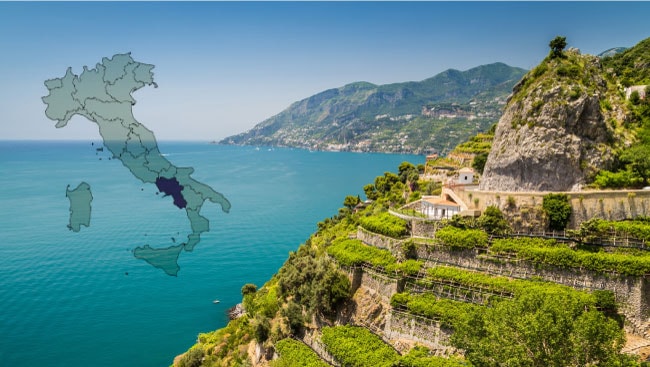
The influence of ancient empires – Greek, Roman, Byzantine – noticeable by the number of legends that surround the local varieties and wines. It is the home of one of the oldest wines of Italy – Falernian (Falernum).
Varieties and wines
Italy in General is known for impressive varietal diversity, and the Campaign is no exception.
The most important variety in the region is the red Aglianico. It is the basis of most respected red wines of Campania: Taurasi (Taurasi) and Aglianico del Taburno (Aglianico del Taburno). Aglianico arrived here with the Greeks and later cultivated by the Romans already.

The second most common red variety in the region – piedirosso (Piedirosso), which is a local autochthonous. However, the significance and reputation he is inferior Aglianico and is used mainly in the composition of blends.
Important white varieties of the Campaign are Fiano (Fiano) and Greek (Greco), and the best wines based on them, respectively, Fiano di Avellino (Fiano di Avellino) and Greco di Tufo (Greco di Tufo).
Fiano is used here more than 2000 years. Its original name – Vitis apianis (lat. “wine bees”) over the centuries has been transformed beyond recognition. Presumably, the name was given to this grape because of its special attractiveness for bees. But this is not accurate.
With the Greek history more transparent. His name is the testimony of the Greek origin of the variety.
Falanghina – another interesting light-skinned variety, which are based on such wines as Falerno del Massico and Galluccio. Honey sweetness wines from falanghina have earned them fame, sung to the ancient philosopher Pliny the Elder, thus, to whom is attributed the authorship of the expression in vino veritas. It is about the legendary Falernian wine.
Aside from the mentioned headliners, the Campaign is home to a number of lesser-known varieties, in particular, biancolella (Biancolella) and Forastero (Forastera). This couple is the basis of the white wines of Ischia (Ischia).
Spezza (Suppezza), Sabato (Sabato) and Madinat (Sciascinoso, Olivella he for the similarity of its berries with olives) varieties that play a significant role in the wines of the Sorrento Peninsula.
Amalfi coast wine communes furore and Ravello bright flavour, with a dominant orange blossom. They are based on local varieties phenyl (Fenile), Ripoli (Ripolo), pepella (Pepella) and Ginestra (Ginestra).
On the plains of Aversa variety of aspirini known cheerful sparkling wines, gives the name of the appellation Asprinio di Aversa DOC.
And finally, variety: Coda di Volpe (Coda di Volpe, literally Fox tail), so named because of the elongated shape of its vines, completes varieties of verdeca (Verdeca), Greco di Bianca (Bianca Greco di) and falanghina (Falanghina) in white volcanic wines Lacryma Christi del Vesuvio (Lacryma Christi del Vesuvio).
The success of the Campaign as a wine region due to the diversity of terroirs and microclimates presented on an area of about 47 hectares of its vineyards. The vines thrive in conditions of plentiful light, dry hot summer, mild winters and a long growing season. Plus volcanic soil, through which the phylloxera has failed to do terrible damage. The coastal Mediterranean breezes blowing in from the Tyrrhenian sea, soothing the heat and allow the berries to preserve the bright acidity.
The difference between microclimates the region was highly noticeable. For example, falanghina from the slopes away from the coast has shown a greater aromaticity compared with wine produced from coastal areas.
Wine Campaign today
Modern wines of Campania are not hiding behind the traditions: they are youthful and open, with bright fruit character. White is known for its flavour, often reminiscent of the local flora. Reds, particularly from Aglianico, can Express individuality and require time to Mature.
The latest production methods allow winemakers Campaign to significantly improve the quality of its wines, in particular, due to more competent working with the vines, the harvesting methods and practices of work in the cellar.
Of the names stands out Antonio Mastroberardino (Mastroberardino, Antonio, 1928-2014), whose ability to combine tradition with innovation made him the most respected winemaker of modern Campaigns.