
Spain is a country of breathtaking landscapes, colorful history and a deep, complex culture in which wine centuries holds a very prominent place.

The vines are grown on the Iberian Peninsula since at least 3000 BC century, However, serious winemaking appeared here about the 1000 century BC, when Phoenician traders brought with them skills in the production of wine from the Eastern Mediterranean.
Today in Spain more grape vines than any other country in the world, and the volume of wine production after Italy and France.
All 17 administrative regions of Spain (Autonomous communities) somehow produces wine. Some of them has the same regional appellation such we noted marked DO (Denominacion de Origen). Part have regional class Vino de la Tierra (marked as VT). In the rest of the appellations represented only specific areas within the region:
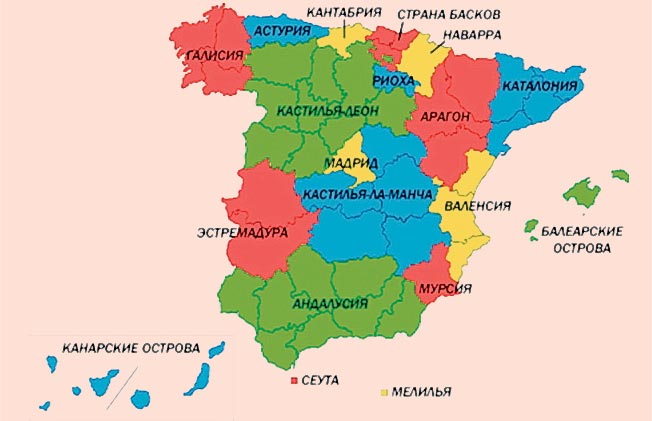
The largest concentration of vineyards is in Castilla-La Mancha. But the best and most famous wines come from Galicia (RIAs Baixas), Catalunya (cava and Priorat), Andalucia (sherry), of Castile and Leon (Rueda, Toro, Ribera del Duero) and, of course, Rioja.
A crucial role in shaping the style of all the major wines of Spain played by geography and climate. The country’s landscape is very diverse: from the cold and the green of Galicia with the snowy caps of the Pyrenees in the North, through the arid plains of the Central part to the sand and sun of southern Andalusia. The country stretches over 7 degrees of latitude, covering a width of 800 kilometres of land between the Atlantic and Mediterranean coasts.
Between these two very different coasts, the landscape is crossed by an equally different mountain ranges, each with a specific influence on regional climate. The Cantabrian Cordillera, for example, created a striking contrast between covered with rough vegetation of the Northern part of the Atlantic, dry and scarce on the South side – the territory of Castile and Leon.
Amid mountain peaks and plateaus rivers are born, from which depend numerous vineyards of Spain. Their importance is not only that they are sources of critical water, but also in the impact they have on local soil and mesoclimate.
The most important wine rivers of Spain is: Minho (Miño), Douro (Duero), Tagus (Tajo), Guadiana (or Guadiana, Guadiana) and the Ebro (Ebro).
The first four flow West flow away to Portugal, where they become, respectively, the rivers Minho (Minho), Douro (Douro), Tagus (Tejo) and the Guadiana same.
The Ebro river flows to the East and remained Spanish throughout its length, crossing some of the most important wine regions. Descending from the mountains of Cantabria, the Ebro flows through Castile and Leon, Basque Country, Navarra, Rioja and Aragon, ending its journey on the Mediterranean coast of Catalonia.
As the climate, Geology and topography of Spain is heterogeneous, and the different styles produced in the wine country.
Cool “far North” and North-West work light, brisk white wine, typical examples of which are wines of the RIAs Baixas and Taste (Txakoli).
In warmer and more arid regions to the South, inland to Rioja, Ribera del Duero and Bierzo – more typical are medium-bodied red wine with a fruity bouquet.
Closer to the Mediterranean coast – the territory of more full-bodied and powerful red (Jumilla), except in mountainous areas, where lower temperatures and humidity enable the manufacture of lighter red, and especially well – sparkling white (cava).
Sherry it is hard to attribute to any climate group, since it is a separate type of wine, where the leading role is played by the winemaker and production methods, and not climatic conditions.
Grapes
The range of wine varieties in Spain is not as crazy as, for example, in Italy, and grades are not such a focus of attention. Only recently, Spanish winemakers began to practice variety-oriented winemaking and marketing. In varying degrees, on the Spanish wineries use several hundred varieties of grapes, but the vast majority of wines are produced from a relatively small set of them.