
Austria is mountainous, not a landlocked country in Central Europe, which is experiencing a real Renaissance of the national winemaking.
Having done a long way from the long decades of conflict and desolation in the industry to actually cutting edge of European wine – a leader in quality and innovation, Austria has managed to find balance between tradition like sweet wine Ausbruch (Ausbruch), “straw” Stravin (Strohwein) and the creation of modern wines like recognizable samples from varieties grüner Veltliner – a poignant, fresh, friendly.
Grapes
Officially, the production of high quality Austrian wines 35 permitted grape varieties, of which almost two thirds are white. Among them in the first place in terms of production of grüner Veltliner on the second – a Riesling.
The best wines of these varieties are doing in the regions of Kamptal, Kremstal and Wachau.
Other white varieties, important for winemaking in Austria: Chardonnay, Sauvignon Blanc, Welschriesling and Pinot Blanc (Austria. Weissburgunder Weissburgunder).
Austrian red made mainly from the varieties blaufränkisch, Zweigelt, St-Laurent (or Sankt Laurent in German), Pinot Noir (aka blauburgunder Blauburgunder).
The geography of wine
Austria is located in the heart of Europe, between 46 and 48 North latitude – on the same level as Central France and South of Germany. It is logical that here is a little warmer than in Germany, which is reflected in the character of the wine: Austria pays much more attention to red wines than its neighbor to the North.
But winemaking is not only important latitude. A key role in the birth of Austrian wines is played by the topography. In the landscape of a large area of the country, especially in the Western part, dominated by the cold Eastern Alps. And in the East extends a warm Pannonian (Pannonian) plain.
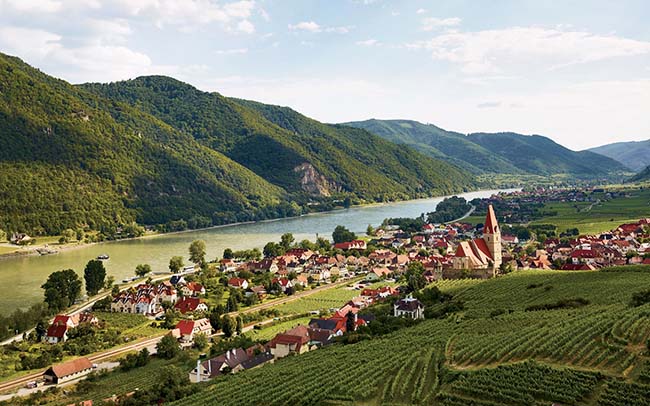
Wine regions of Austria are concentrated mainly in the North-East of the country, within the boundaries of the Federal land lower Austria (Niederosterreich), bordering Hungary, the Czech Republic, Slovakia and Slovenia.
From the Mediterranean influence of Austria, separated by the Alps, so the climate here is sharply continental, with significant changes in daily and seasonal temperatures. Of course, between local climatic extremes lies a wide range of local mesoclimate, sometimes smooth large bodies of water such as the Danube river (in southern regions), and lake Neusiedl.
Wine of Austria dates from Roman times. Traces of viticulture 2000 years ago was found near Carnuntum (Carnuntum) and Thermenregion (Thermenregion). Steep terraces along the Danube and its tributaries in the Wachau and Kamptal was arranged by the monks of the monasteries of Bavaria, and Salzburg.
The vineyards of Vienna actively supported the tradition of “Heurigen” (heurigen) – national restaurants and taverns that served by a young local wine.
A large part of the 20th century Austria was associated with a massive sweet wines of the varieties müller Thurgau and grüner Veltliner. But today, manufacturers focus on fresh, dry white wines, some of which are able to develop good.
This was facilitated by the scandal of 1985, when some wines of mass production found diethylene glycol, a key industrial component of antifreeze, which unscrupulous manufacturers added to wine to give it more sweetness and density.
This scandal was a disaster for the wine industry of Austria, both in terms of reputation and in terms of exports. Then I was introduced stringent laws and the wine industry managed to revive.
Regions and classification
The wine list Austria are 13 main regions, some of which coincide with the administrative units, of the pure wine categories – controlled names of origin of wines (the appellations, see below).
The main wine regions of Austria:
- Bergland (Bergland)
- Burgenland (Burgenland)
- Carnuntum (Carnuntum)
- Kamptal (Kamptal)
- Kremstal (Kremstal)
- Lower Austria (Niederosterreich)
- Styria (Steiermark)
- Thermenregion (Thermenregion)
- Traisental (Traisental)
- Vienna (Wien)
- Wachau (Wachau)
- Wagram (Wagram)
- The Weinviertel (Weinviertel)
In 2003, Austria introduced a system of appellations – DAC (Districtus Austriae that guarantees their), an analogue of the French AOC. As in other such systems, there are separate requirements for wines from different terroirs in terms of output per hectare, fortress, oak aging, etc. Meaning, of course, is to guarantee the consumer a line of wines with an indication of the DAC to the classic style of the area.
To 2018 in Austria, established 13 categories of the DAC:
Austrian wine laws are largely based on the laws of neighboring Germany. The Austrian classification of wine quality is based on the density of the wort (the sugar content of the grapes) at Klosterneuburg table (Klosterneuburger Mostwaage or KMW).
Distinguish 3 levels of quality Austrian wines:
- Tafelwein – table wine
- Qualitatswein – quality wine
- Pradikatswein – wines of the highest class differences (in production)
The terminology of the Austrian label also similar to German, but the demands of the sugar content of the wort is slightly higher (still warmer region).
In the Wachau region, which still has no DAC, particularly concerned as manufacturers have developed three-level classification system:
- Steinhude (Steinfeder) – the light, fresh wine
- Filesel (Federspiel) – more compact and elegant
- Smaragd (Smaragd) – the most complete and rich
Source: wine-searcher.com May 2019