There are many ways to make sweet wine. But the brightest of them resemble Russian roulette.
The fungus Botrytis cinerea (Botrytis of cinerea) attacks the grapes – and sometimes other parts of the vines in conditions of high humidity. It can develop into a destructive gray rot, but at successful coincidence of circumstances developing as a desirable Botrytis, the berries hitting the so-called “noble rot”. Many of the great sweet wines of the planet is produced from the brown, shriveled and covered with fuzzy mold “botrytised” berries:
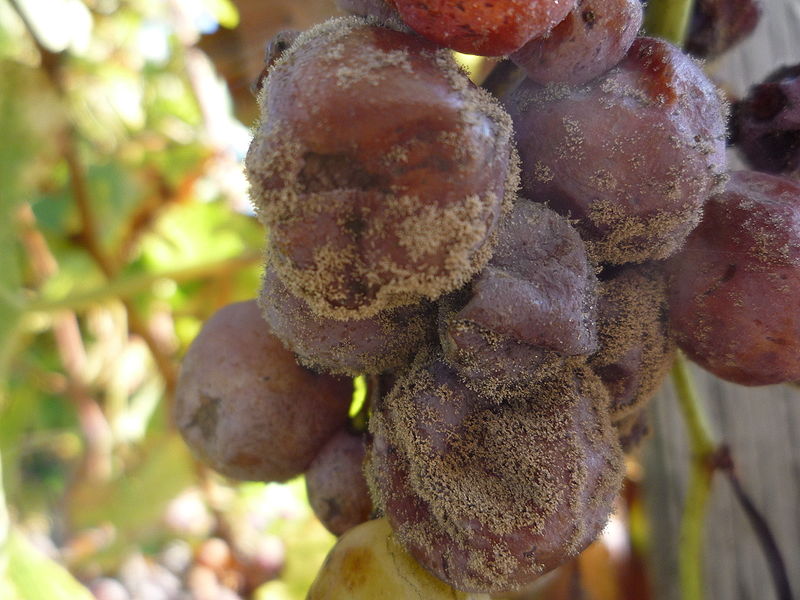
Botrytis in the vineyards
The vineyards of the best sweet wines in the world are often located near water, where the formation of fog in places merge quick cold tributaries with calm warm waters of the mainstream – as in the case of the Hungarian rivers Bodrog and Tisza in Tokaj or French CIRON and the Garonne in the Sauternes. In this environment, you need plenty of sun to dispel the fog and warm the berries throughout the day to curb the growth of moulds and fungi and to ensure full ripening.
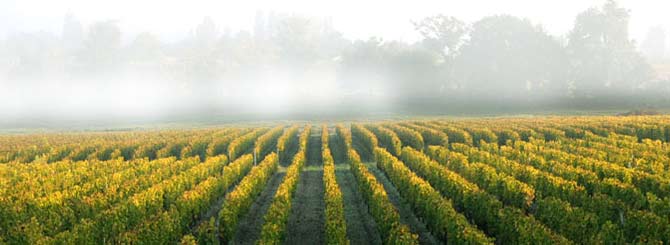
Foggy vineyard of Sauternes
But in most other cases the noble rot occurs when the threshold of the harvest season, the rainy season gives way to a succession of dry days. For example, in New Zealand winegrowers Marlborough in a hurry to harvest Sauvignon if in season there is a threat of loss due to rain, while a small part still left on the vines in the hope that the changing weather will create the necessary conditions for the development of noble rot.
Some varieties more than others susceptible to rot because of more delicate skin and a high density bunches, preventing the blowing and drying berries. Especially prized Semillon, with a thin rind and a rich buttery character. From other popular in this respect to white varieties, you can highlight the Sauvignon Blanc (the younger brother in most of the Sauternes, important for its contribution to the formation of the desired acidity), Chenin Blanc, Riesling, Gewurztraminer and Tokay Furmint.
Red varieties almost are unsuitable for botrytised wines as the Botrytis destroys their anthocyanins, colouring is a must in brown tones with the formation of odors from phenolic compounds of the skins.
However, with the development of knowledge and technology, attempts are periodically taken and the most rewarding of the major red varieties were Merlot and Pinot Noir.
In fact, Botrytis cinerea all year round present on most vineyards. But begins to develop only in the right conditions. The fungus can overwinter as mycelium or sclerotium (tightly woven threads of mycelium) in the dormant buds, the bark of the vine or plant residues in the soil. The most frequent resting place are considered old stems bunches. For this reason it is important to immediately remove the results of the pruning from the vineyard, are prone to infection.
Control the spread of the mold is reduced to a number of fundamental practices, such as providing produvaemosti vineyard and prevent the formation of too dense foliage that impede not only the ventilation of the vines, but her treatment fungicides. However, in modern sustainable vineyards against the spraying of chemicals is strictly disapproving, and Botrytis are able to develop resistance to most fungicides.
Wet night and early morning at the end of the season (somewhere at the end of September for the Northern hemisphere) allow the mold to produce the infection and begin to develop. After that, you need an offensive dry warm days to restrain its growth.
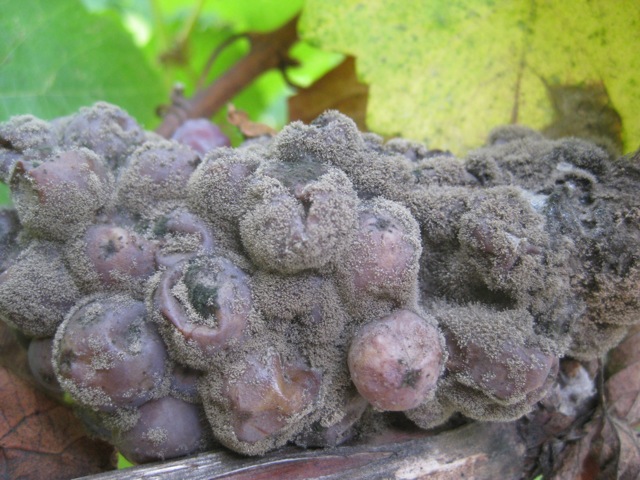
Gray mold on the berries of Pinot Noir in champagne
Destructive gray rot develops in the case, if the fungus Botrytis causes the berry to drying and shrinking and cracking, causing further fungal and bacterial contamination. This can happen early in the season, if warm, humid conditions will develop until the berries are not yet ripe: the time of beginning of ripening, when the berries begin to change color and become softer the most dangerous. Continuation of the period of high humidity will also lead to the spread of the fungus in the vine and the development of Botrytis, which will ruin the crop.
As “works” fungus
The structure of the mycelium and sclerotium on the vine waiting for a sufficient amount of moisture (about 15 hours continuous rain, fog, dew or irrigation) and nutrients (especially sugars) in ripening fruits to spread spores, forming millions conidiophore structures, resembling under the microscope the branches of a tree. Subsequently, they will dismiss the conidia, which are fixed on the fruit.
The bulk of the fungus develops on the surface of the berries, however, spores (conidia) form individual filaments that penetrate the peel into the pulp. The lack of moisture in the environment they extract water from under the rind of the fruit. The development of the rot lasts about a month before harvest.
Once the berry, the fungus secretes enzymes that destroys the pectin components of cell walls. Sugars begin to concentrate and mold begins to change the acidity of the berries are: tartaric acid melts significantly as a result of its metabolism. Thus, on the one hand, the grapes must be ripe at the defeat of the mold, for the production of dessert wines, it should not be too ripe, otherwise it will not be sufficient acidity, which provides a sweet wine balance and potential maturation. And again we come to the fact that an important near-gem choice time picking berries.
Meanwhile, the glucose in berries is oxidized to gluconic acid, a process responsible for the development of the honey and apricot character of the botrytised wines. The intensity of this oxidation varies depending on the grape variety.
The level of lactic acid, according to the observations, has remained relatively stable, and its concentration increases in proportion to the rest of the components with decreasing amounts of moisture in the berries.
Berry shrinks and loses water, but should not crack if used in a botrytised wine. In the end it will be only a couple of drops of the precious liquid. The process of drying the berries and increasing the concentration of the juice alters the metabolism of mould Botrytis and stabilize its development. During the process a number of antibiotics, including Botrytis preventing other bacteria and fungi to intervene in the formation of aroma and phenolic to form an unpleasant tone.
The microclimate around the vines are heterogeneous, so individual berries on the clusters can be different degrees of decay mastered. Irregularities in the spread of mold and visible from vine to vine in different parts of the vineyard. For the top producers of Bordeaux, Loire, and wherever it is, it means the necessity of repeated passage through the vines in the growing season to ensure more or less smooth result. Botrytised grapes may require up to ten fees per season for the gradual selection of berries with the required degree of development of noble rot.
Only a few manufacturer level Sauternes Grand CRU can afford the price tag for a bottle that would justify such costs to repeated hand picking. The rest is collected once, and the selection of grapes takes place at the winery. A significant reduction in the yield of wine per hectare (up to 20% of the standard crop) and the risks associated with leaving the berries on the vine in terms of development of Botrytis, seriously inflate costs.
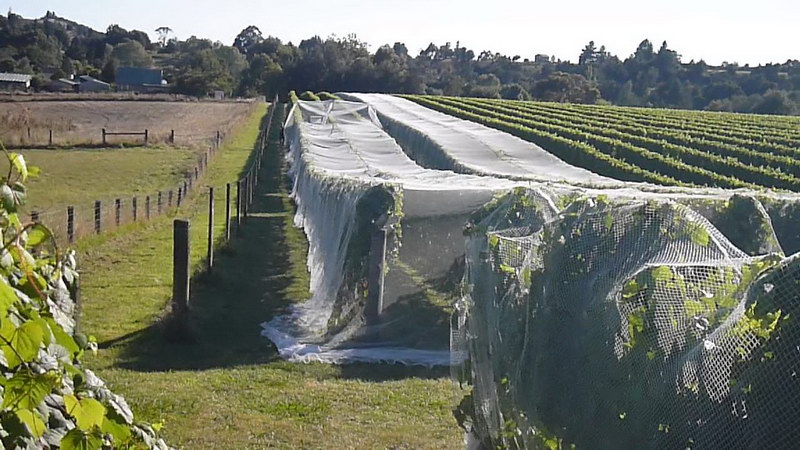
Grid against birds in the vineyard
Plus hungry birds peck out whole berries and damaging the adjacent, provoking the development of Botrytis. It again costs for purchase, installation and dismantling of special meshes.
Botrytised wine in the world
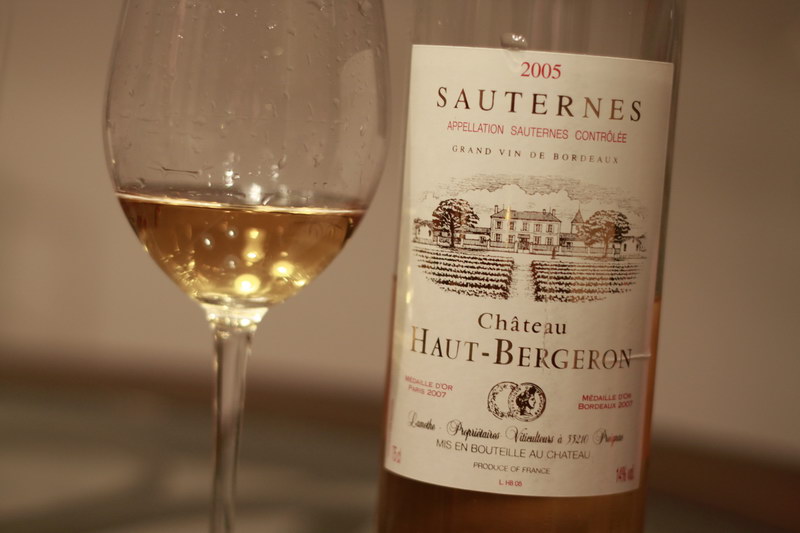
The best vineyards are characterized by sufficient regularity conditions necessary for the proper development of Botrytis cinerea to specialize manufacturer for sweet botrytised wines were economically justified. However, even in the price of the best CRUs of Sauternes (France) laid down the “option” pass approximately every fourth year, when sweet wine from the vineyard is not made, and the wine goes into the “beam” by the glass Bordeaux Blanc (plain white Bordeaux wines). There are such years when a sweet wine is produced, but it botrytised character is not so bright as we would like.
In Germany from botrytised grapes produce great wines Trockenbeerenauslese. However, terroirs here do not allow winemakers safe to rely on this type of wine. Many German wineries produce from a single vineyard range of wines of different style, leaving a few rows of vines at different sites for the potential production of botrytised or ice wines.
German wine classification is based on the sugar content in the finished wine and in grapes. Berries class Kabinett, Spätlese and Auslese can be dry spojeni, in the case of the first two noble rot is rare.
Berries categories of Beerenauslese (selected late harvest) and Trockenbeerenauslese (select parched) must contain such an amount of sugar which cannot be completely spojeno and, therefore, automatically mean the production of sweet wine. And it’s almost always wine made from botrytised berries. The ability to use berries, not desiccated by Botrytis, and the sun, the law is valid but because of the climate remains rather theoretical assumption.
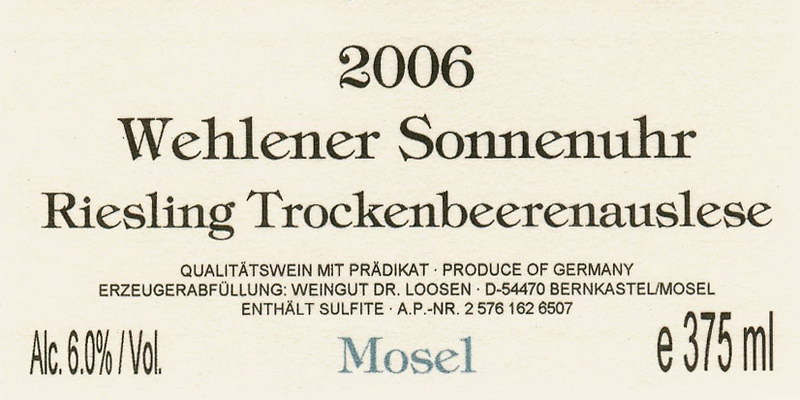
German botrytised wine from grapes Riesling trockenbeerenauslese category
Botrytised wines were made for centuries in different parts of Europe, where he developed suitable conditions. But it is obvious that the first samples were not intentionally.
Based on historical documents it can be assumed that the primacy belongs to the Hungarian Tokay.
Laczkó Máté Szepsi (the ancestor of the modern leading manufacturer Istvan Szepsy) first documented a process ACS (Aszú) in 1630, although there are inventory documents mentioning the wine, type of ACS, dated about 1571 year.
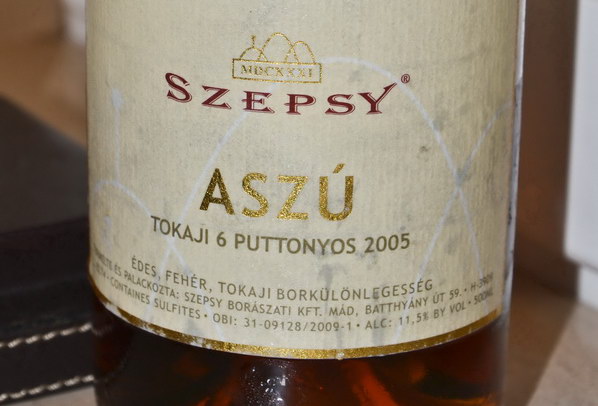
Aszú translates from Hungarian as “parched”, but has long been associated with noble rot.
The first Tokaji wine was sent from Transylvania to France to the court of Louis XIV in 1703, where it eventually became known as not only as and Vinum Regum Rex Vinorum (wine of kings and king of wines) and gave a significant impetus to the development of the production of botrytised wines in Sauternes, well-established by the mid-19th century.
In the Loire Valley, rich in fine botrytised wine made from Chenin Blanc varieties. These are areas such as Bonzo (Bonnezeaux), shom (Chaume), and quart de Chaume (Quarts de Chaume).
In Alsace the wine Seleccion de Gran noble (Selection des Grains Nobles) made from Pinot Gris, Gewurztraminer, Riesling and Muscat.
In Germany and Austria the most prestigious sweet wine – a Riesling. In Germany although in the course of and varieties like scheurebe (Scheurebe) and Sylvaner.
The Austrian town of rust, on the shore of the Neusiedler see, known for its dessert wine Ausbruch (Ausbruch) – the Austrian equivalent to ASU from a range of varieties including Chardonnay, muskateller, Sauvignon Blanc and Welschriesling. Once there dominated Furmint as a reflection of the historical proximity of the city of rust with Tokai, but now he’s here quite a bit. However, we can see pink dessert wine from Pinot Noir.

Vintage wine label 1950s Ausbruch from Pinterest
Most regions are producing botrytised wines in both hemispheres are characterized by relatively cold and humid mesoclimate. Apart from them stands in Australiai Riverina (New South Wales): there are hot summers and low annual rainfall. Conditions for development of Botrytis in the region creates a rainy late autumn and humidity late in the season.
In warmer regions – as, for example, much of California – only a few vineyards have a fairly damp climate, but they are the production volumes fluctuate considerably from year to year. Inspired by the Sauternes producer Far Niente in the NAPA Valley have tried a variety of methods in attempts to achieve a more stable production, up to the experimental plots cultivated by Botrytis, but only stated the best score on normal neighboring. Now there rely solely on natural factors in the hope that the noble rot will dry up their Semillon and Sauvignon Blanc, and sometimes only 5% of berries grown in the end going to the wine, and a significant portion of the crop often eaten by wasps.
In contrast with him is the Nightingale botrytised wine from another nepskogo producer Beringer. It is made with the use of a mold, derived in the lab at the winery. Cultured Botrytis hooked on the collected berries, located on pallets in the room with 100% humidity that is maintained for 33 hours, after which is given 14 days to development of rot with the constant blowing fan. The wine before selling several years aged in oak barrels, and critics speak of it very flattering.
Botrytis in the winery
The pressing is affected by Botrytis grapes is a tricky business. Requires very careful pressing without crushing, to avoid contact with the wort of unwanted bacterial or fungal infections, which can spoil the taste of the wine. In contrast to the classical dry white winemaking, the best here is not the first extraction, and the subsequent fractions, because they have higher sugar content and protezirovanija Botrytis aromatics. The most withered berries may require a series of pressing, to extract from them at least some moisture!
A classic wine of Sauternes provides a very slow fermentation: for two months or more. Even the yeast is specifically selected hard to do their job with such a huge amount of sugar. Besides, botrytised wort contains antibiotics (in particular, Botrytis), while poor in nutrients needed by the yeast, such as ammonia and thiamine (vitamin B1). Because of this, frequent cases of arbitrary stop fermentation.
The development of Botrytis cinerea also accompanied by the formation of a number of key polysaccharides, mainly polymers of mannose and galactose, plus a certain amount of glucose and ramnose with antifungal properties that suppress the fermentation and increase the content of acetic acid (volatile acidity) and glycerin. Acetobacteria from the surface of the berries can significantly increase the level of volatile acidity (acetic acid and ethyl acetate). If it is balanced by other components, it adds complexity guilt, if dominates, then it becomes a defect of the wine.
Special attention should be paid to prevent re-fermentation, because many of these wines, the residual sugar is enough to boost their fortress for another 5-6 volume%. Once the fermentation reaches the desired balance of alcohol and residual sugar, it is interrupted by the addition of sulphur dioxide.
After completion of the fermentation, the wine turns cloudy. Moreover, it is not easy to clean due to the presence of woven into other substances krupnomasshtabnykh kluchanovich colloids that do not settle are not amenable to pasting and require cold settling for several weeks to make the particles bigger and to allow conventional filtration or centrifugation without immediate clogging of the equipment. To accelerate this process the wine regulations of the European Union allow the use of the enzyme glucanase.
For guaranteed stop fermentation along with the sulphur dioxide using cold stabilization. But despite this and all the tortures with filtering, Sauternes and similar wines tend to form a crystalline precipitate. And all because Botrytis produces sugar and acid mucin, which subsequently form the insoluble calcium salt in an already bottled wine. For consumers, they are completely harmless, but some are confused by.
Although in botrytised wines stored malic acid, malolactic fermentation for them – a rarity, because of the sulfur dioxide that is added to interrupt fermentation. If not him, then high levels of sugar and glycerin would certainly contribute to malolactic.
Top Sauternes can bottled after 16 months of aging in new barriques (oak barrels 225л). Australian botrytised Semillon can spend up to 3 years in a barrel. But the wines of the Loire and Germany are usually bottled next spring. The Tokay is traditionally made of oxidative aged in partially filled barrels; the risk of microbial spoilage is reduced due to the large amount of sugar and high alcohol level.
And in the process of vinification, and at the stage of bottling, these wines require a sulfur dioxide in amounts above the average, as produced by the Botrytis enzyme laccase increases the tendency of wine to oxidative processes, and it does not relieve the usual amount of sulfur. This is the main reason rich amber-hued dessert wines. Besides, gluconic acid, synthesized by any trapped in the wine acetic acid bacteria, forming lactones linking the sulfur dioxide. These two circumstances cause for botrytised wines in the European Union allowed a higher level of application of sulphur dioxide.
Aromas of Botrytis in the glass
Botrytis converts a compound in the composition of the wine, essential to building his bouquet (including terpenes, which apparently is the source of “medical” shades of botrytised wines) and produces a new such as sotolon normally associated with honey aromas. It’s clear that some varieties, like Muscat, are losing more varietal characteristics than others – for example, Riesling and Semillon.
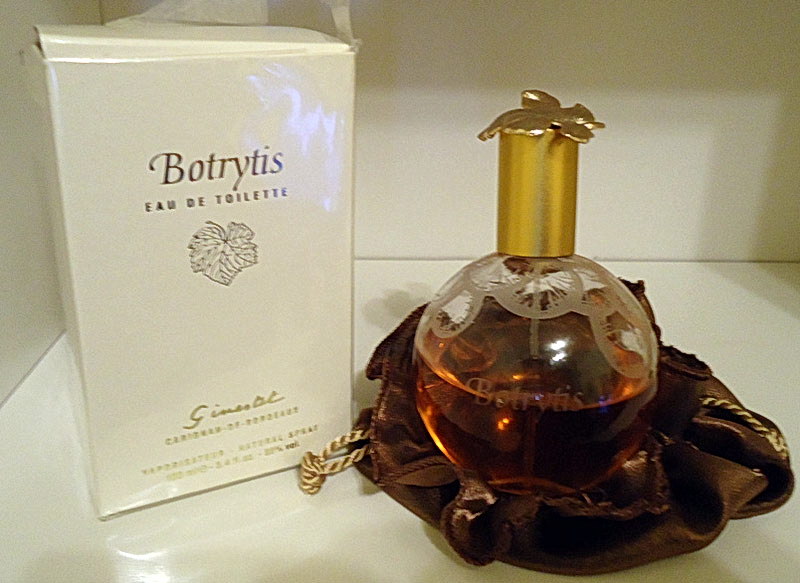
Free water on the subject of aromas of botrytised wines
Part of the definition inherent in the descriptions of wines with noble rot, such as honey, flowers, ripe apricot, dried fruits and marmalade – it is applicable to dessert wines made by other methods, for example, so-called “straw” wines (strohwein, vin de paille).
Recognition of botrytised wines in a blind tasting usually relies on a combination of the characteristics mentioned above with the “medical” range of aromas with notes of wet wool or wet plaster.
Author: Tom Jarvis for the portal wine-searcher.com 14-Jul-2017