

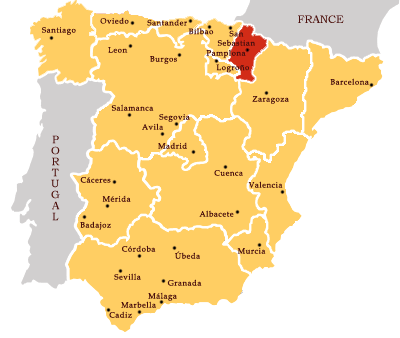
Navarre (Navarra) is one of 17 major administrative regions of Spain and the eponymous wine region in the North of the country.
Traditionally Navarre was associated with a cheerful pink wines from Garnacha with a fruity bouquet, but now more and more attracts the attention of her red, high-quality wines from Tempranillo, Cabernet Sauvignon and Merlot, which is gradually emerging from the shadow of its famous neighbour Rioja.
The first mention of wine in this region belong to the Roman era, but it is obvious that the grapes were common here long before that:
In Navarre still grow the vines of the prehistoric Vitis species be sylvestris, the ancestor of the modern cultivated vine Vitis of vinifera.
After the Romans the local winemaking was continued by the Moors, and then received significant development with the Christians. The demand for local wine is fueled by Catholic pilgrims, was on his way along the Camino de Santiago in the Galician city of Santiago de Compostela where according to legend is the grave of St. Jacob.
In the 14th century was a real boom of winemaking in Navarra, when the area of vineyards has grown so much that I had to take restrictive measures to keep arable land under grass, not to leave the local population without food.
At the end of the 19th century – again explosive demand, this time caused by the outbreak in France by the phylloxera epidemic. But this grace did not last long, because pretty soon she Navarra fell victim to this pest, losing a significant portion of their vineyards. As elsewhere, had to graft local vines on phylloxera-resistant American roots, and thus, was able gradually to restore the vineyards and wine production.
The appellations and sub-regions of Navarra
In Navarra there is only one common appellation (denomination) – DO Navarra, created in 1933 and covers the entire southern half of the region (almost all of the territory South of the administrative capital, the city of Pamplona). DO this is governed by a local governing Council (Consejo Regulador), located in the small town of Olite.
The geography of Navarra is diverse. Development of the vines and the ripening of grapes is influenced by the proximity of the Bay of Biscay in the Northwest, the Pyrenees in the northeast and the Ebro river. Along with the influence of the Mediterranean climate, they form the character of the local wines.
Such a great variety of geographical factors led to the identification of five sub-zones of winemaking in Navarra:
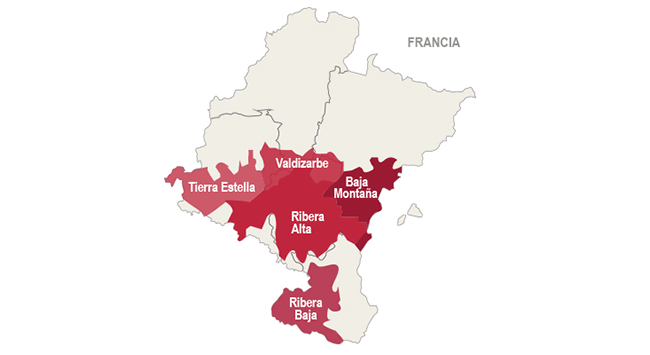
A small piece of the administrative territory of Navarra falls within the boundaries of the wine area of La Rioja (DOC Rioja).
Wines Of Navarra
The traditional view of winemaking in Navarra associated with pink wines (rosado), a particularly successful of which was produced from Garnacha. It’s mostly dry specimens with pronounced fruity notes, well combined with the local cuisine.
The success of the wines based on Tempranillo encouraged many local winemakers to make greater use of this renowned Spanish favourites in their wines and now it begins to noticeably restrict the former leader of the Garnacha in the production plans.
The current trend in the region – intense red wine with a fruity bouquet, but without the influence of oak.
In addition to Tempranillo and Garnacha, among a good varietal experiments of the region – wines from Cabernet Sauvignon, Merlot and Pinot Noir.
A very small number of white wines of Navarra is mainly of Chardonnay, viura and Garnacha Blanca.
The rules DO Navarra also allow the production of natural sweet wines from the Moscatel varieties.
Investments in modern equipment, the use of international grape varieties and the efforts of some courageous winemakers has led to the emergence of new styles of wine in Navarre, and made the region interesting for further acquaintance.