
According to Jamie Goode (Jamie Goode), is popular with many sommeliers, the term “minerality” in a wine description, often criticized as dubious and misleading.
Is it possible to say that the properties that are usually described as “minerality” of the wine, are relevant to the minerals? And if they say something about the ability of wine to slow?
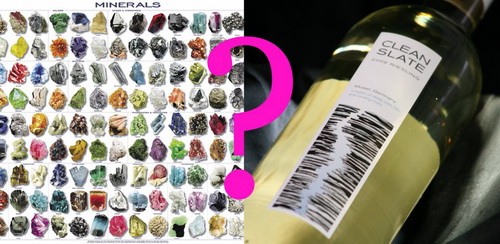
Tasting notes this term is a relative newcomer. This characteristic began to appear only in the 1980s, before it no one used. Since the word firmly entered the lexicon of tasters, but recently there has been a noticeable decline in enthusiasm in its application.
Criticism of “minerality” is based on two things:
First: this term has no clear definition. Different people understand it differently and use it to describe the different characteristics of the wine. This is clearly demonstrated by the experiment conducted by Ballesteros Jordi (Jordi Ballester) in Dijon, during which we investigated the use of this term by professionals.
Second: the idea that minerals can be taken the vine from the soil and then affect the taste of grapes (wine), subjected to scientific criticism. That is, according to biologists, is impossible in principle.
But…
I really like this term. And I want to make a heretical suggestion: maybe, after all, a possible link between the “minerality” of the wine and its vitality? And that very boldly: if the second to be a consequence of the first? Before I diverge in their heresy, let’s look at the issue.
The current scientific consensus is that the composition of the soil affects the quality of the wine only by the mode in which the vine gets water. According to this idea, the ideal vineyard vines have enough water but not in excess, and the vine at the right moments experiencing micro-stress associated with lack of drinking. According to this theory, the chemical composition of the soil does not matter.
But, according to many growers, not only is the visibility of moisture in the soil, but the chemistry of its layers. Soil type plays a role beyond its drainage characteristics. From the point of view of botany, it is possible that the mineral composition of the soil can have direct and indirect effects on the bouquet of the wine.
Direct – due to the minerals collected by the roots from the soil and entering the berries and, consequently, in the wine. It is unlikely that this effect is markedly noticeable – since most of the ionic minerals have no odor and almost no taste at all – but still may be important.
In fact, there is evidence that the type (composition) of the soil can influence the chemical composition of the wine.
In 2000, the German botanist Andreas Peuke grew Riesling vines in pots with three different soils from Franconian vineyards: loess, Shelly limestone and Kuiper. After collecting the juice from the stems of the vines, he conducted chemical analysis and found differences in the composition.
Of course, this is not the most outstanding research on this topic. But it demonstrates the fundamental possibility of what we say.
The indirect effect consists in the influence of minerals (their presence or absence) on the expression of genes in plants, leading to unequal formation of aromatic compounds and their precursors (starting compounds) in grape berries.
Besides, the chemical composition of the wort has a significant impact on the work of yeast and bacteria in the fermentation process, changing the course and proportions of the formulation by microorganisms aromatic compounds.
Where in the soil minerals?
The bulk of the mineral components of the soil formed by the decomposition of organic material, rather than the destruction of stones 🙂 the capacity of soil to decompose organic matter into mineral ions that can eat plants, responsible living activities of microorganisms.
There are three forms of “minerality” of the wine:
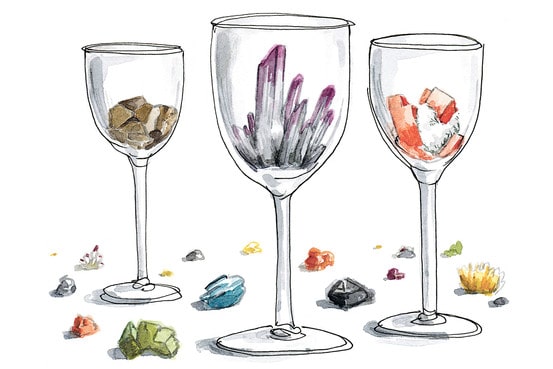
The first mineral flavor
It is usually feel in white wines.
Source of mineral – or “match” the tones are, apparently, volatile sulfur compounds formed by yeast during fermentation.
Classic tone “carved flint” or matches, inherent in the white wines of Burgundy (especially Chablis), is actually quite attractive. Producers of Chardonnay around the world do not like to repeat it in their wines.
The other two forms of minerality – a description of the taste
One (the most controversial) is associated with high acidity of white wine. Many easily give the characteristic “mineral” bright acidic white wines, while the term “high acidity” is more appropriate. The situation is similar – with wines described as “stony”.
Another – in my opinion, the most useful features – a special kind of salty minerality, like the one that we perceive in the mineral water, only much less intense. Rather, it refers to the description of the “structure” of wine.
So, back to the heretical question of the relation of “minerality” of the wine and its ability to slow.
I’m hardly able to give it precise scientific justification, but many wines that I would describe as more mineral seem to have more potential for aging, less than their mineral counterparts. This is especially true for white wines.
I have repeatedly faced with the fact that white wines have proven to be more tenacious than expected on the basis of these estimates.
The scientific position is that from the oxidation of white wine protects free sulfur dioxide, which contributes to low pH (i.e. high acidity), because in such an environment, more sulfur dioxide is in the active state (acid itself is not a protection against excessive oxidation).
However, some wines are clearly struggling this logic and show a greater vitality than one would expect them to. In particular, some “eco” wines with very low sulfur dioxide content, which are oxidized in the cellar not so active, and in the open bottle for a long time retain a good shape.
And these persistent white wines have a more mineral characteristics.
A Hungarian winemaker showed me their white wines from the region of lake Balaton. Wines from certain areas was much more long-lived than the surrounding, while all the other factors besides terroir, they were the same. Such circumstances and force me to believe in a “protective effect” produced by the mineral composition of the soil.
The problem is that I can’t clearly describe the mechanism of how this works, probably from a lack of my understanding of the chemistry of wine. However, the wine conceals still many mysteries that do not have a scientific explanation.
Red wine from oxidation and protect the sulfur dioxide that is added to it, and the polyphenols that it contains. And if minerality adds durability white wines, it is logical to assume that red too. Just for Reds, it is not so obvious since they are not fragile by themselves.
The relationship of the mineral character of the wine and its vitality – if any – can be as simple correlation and causation.
The correlation may consist in the accompanying “mineral” taste the higher content of glutathione in wine, which is present in varying amounts in white wines and protects them from oxidation.
Maybe the feeling a certain kind of texture which leaves the mouth a wine with lower content of polyphenols, and in white wines they are, oddly enough, can provoke oxidation, in contrast to the red, where polyphenols protect from it. Some winemakers are practicing preventive gentle oxidation of grape juice for getting rid of excess polyphenols, which can cause undesired excessive oxidation later in the process of vinification.
Anyway, the minerality of the wine – a difficult question, still insufficiently studied and very interesting.