Champagne is a symbol of the holiday and “special occasions”, the companion of important dates, good deals, and solemn moments. The word itself is so saturated with associations that became a household name. Most people (not only in Russia) used to be called champagne, any sparkling wine. Meanwhile, “champagne” is protected European law and the French tradition a name for exceptional and unique drink produced by the earth and the winemakers of champagne.
What makes it champagne is a special wine, the benchmark for sparkling? Being first doesn’t guarantee exclusivity. And it was the first sparkling champagne? About it below. Today it is many excellent sparkling wines around the world. The bubbles are important, but they are no surprise. Champagne and surprises.
So what’s the secret? Let’s face it.
“Another focus there.
Is taken raw, and the sour in all of France and wine, as from the hat of the magician, gets brilliant, the most splendid of all the creatures in the world of wine. That’s why I’m again addicted to champagne.”
(Oz Clarke)
The history of the “invention” of champagne
No matter how attractive a beautiful story about geniuses and seers, historical truth is more prosaic: champagne was not invented. It appeared by itself, because it simply could not appear. Moreover, it appeared rather contrary to the efforts of sparkling wine makers (including the legendary monk Pierre Perignon, which is below) . And only when it became obvious the identity and unique qualities of this wine stood up to him and eventually brought his trade to perfection.
The fact that champagne is the most Northern wine region on the map of France. For a long time it competed with Burgundy producing red wines from Pinot Noir and fought for the status of a supplier of his Majesty the king of France. Produced in the quiet champagne (not sparkling) white wine sometimes do not have time to fully ferment before cold weather sets in. That their wine is still not ready and fell asleep yeast, champagne winemakers did not know. Therefore, when the onset of spring, the temperature in their cellars have risen and awakened the yeast has been started, releasing carbon dioxide – it was all inexplicable phenomenon of nature.
Reviving in the spring, the champagne knocked the cork from the bottle, and often the eyes of the winemaker. The French bottles were not distinguished by their durability, and if the tube is kept in the bottle tightly, then the pressure carried the pieces the bottle itself, sometimes creating a chain reaction in the cellar and bringing ruin to his owner.
All these “charms” champagne white called “the devil’s wine” (le vin du diable). With this “miracle” tried to fight it tried to solve with a single purpose – to get rid of this scourge.
Meanwhile, in Lima
Meanwhile, in the South of France in the commune of Limoux (the wine region the Languedoc) have been producing sparkling wine from local white varieties Muzak (Mauzac) debugged “rural method” (methode rurale) without falling into any hysteria.
The first written mention of sparkling wine “blanket” of Lima (“blanquette” – literally “white ones”) is found in the papers of the Abbey of Saint-Hilaire (Saint-Hilaire) 1531 – that much long before the formation of sparkling champagne.
In the memoirs of Abbot Godino, a Canon of Reims Cathedral (1718 year), it is said that wine with a light color, almost white, rich gas, appeared in champagne about 1668.
Thus, the wine from Limoux can be considered in fact the first white sparkling French wine.
This wine is produced today from local varieties Muzak and sold under its historical name of Blanquette de Limoux (Blanket de Limoux). There’s also other sparkling: Crémant de Limoux (Cremant de Limoux) – wine made by a now traditional (champagne) method from Chardonnay and Chenin Blanc; and the Method Ancestral Blanket (Blanquette methode ancestrale) – i.e. Blanket “method of the ancestors” – technology, which was used in the production of the very first sparkling wines of France. An inquisitive consumer can find all these wines on the shelves of wine shops and supermarkets.
Meanwhile in England
While champagne winemakers fought with demonic bubbles of the produced wines they swam to England. Since the export of wine to leave France until the onset of warm days, to the British it was in a quiet state. As at home, the English, the French champagne sold still wine, not having intentions to make it sparkling. But the laws of physics and biology worked in England are not worse than in France – and brought the champagne was the same metamorphosis.
But.
The English channel was crossed by the wine in barrels and in England it was bottled locally. And the local bottles were much stronger than the French, since glassmakers used coal stoves (not wood, as in France) and the other part of the glass. Besides, due to established trade with Portugal, the British widely used high-quality natural cork; in France, those times often tube served wrapped cloth wooden plugs. Awakened the yeast did its work, and a well-sealed sturdy bottle securely kept the fun under control.
To transport champagne is allowed only in barrels until 1728, when, by the decree of Louis XV, was the ban on the export of wine in bottles.
Because the devil is not ruined cellars of the English, the British appreciated the advantages of sparkling wine and tried to figure out how this goes. But unlike the French – in order to be able to do it again.
And they succeeded.
In 1662 the British scientist Christopher Merret presented to the British Royal Society with an eight-page treatise, “Some observations concerning the supply of wine.” Among others, the document was a Chapter in “How to make sparkling sparkling wine”, by secondary fermentation, which reveals “devil’s secret” – the role of sugar and yeast in the formation of carbon dioxide. The discovery of an Englishman was made 20 years before its “invention” of champagne in France. (Tom Stevenson “encyclopedia of champagne”)
So in England it was first established the production of this sparkling champagne: approximately half a century before the formation of the conscious production of sparkling wines in champagne, but after more than 100 years after the development of the production of sparkling wines “rural method” in the French commune of Limoux.
But what about Dom Perignon?
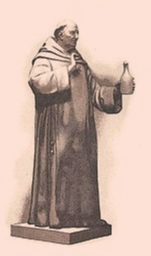
Benedictine monk Dom Pierre Perignon
(dom is from the Latin dominus, a form of respectful address to high officials) in charge of food pantries and a wine cellar of the Abbey of Avila (Saint-Pierre d ‘ Hautvillers) in champagne, as well as the production process Abbey wine. In this position, he was certainly very diligent.
Knowing his close Ministers characterized him as “a perfectionist”. However, the ideal wine, according to Perignon was a wine from Pinot Noir. It, unlike the wines from the white varieties, were less likely to be contentious nature in the spring: to spoil in the bottle and pour cellar foam. Sparkling wine is uniquely applied to his vices, and the Dom Perignon was determined to fight it.
In their quest for the perfect wine Dom Perignon brought many useful and important innovations in the production of Pacific white champagne. For example, he noted a special role and elevated to the rank of art assamblirovanie blending wines from different vineyards, rightly believing that the desired and consistent quality is difficult to achieve without resorting to this technique in extreme winemaking the climate of the champagne region. He also introduced the practice of separating the wort from different stages of pressing: from the very first juice flowing by gravity under the weight of the grapes before the last drops from the press. Tail spin was not used in the production of wine in the assigned home Pérignon Abbey. Under his leadership, the creation of a quiet white champagne made from red Pinot Noir is called Blanc de Noir (blanc de noir) – has reached a very high level.
Thus, the merits of the home of Dom Perignon champagne before wine was regarded by his contemporaries and no doubt now. However, they are not directly related to the development of sparkling champagne wine.
- Champagne “Dom Perignon”