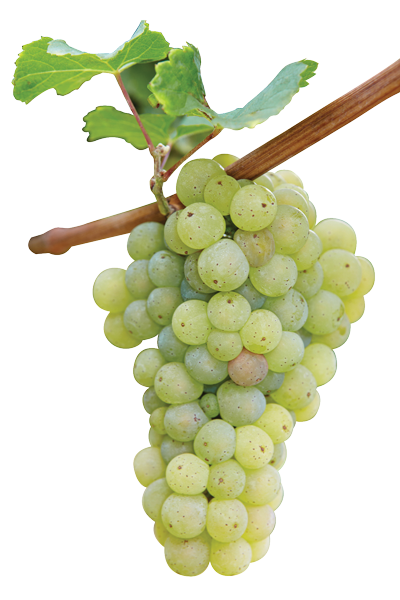
Riesling (it. Riesling) – white technical (wine) grape variety of German origin.
Synonyms varieties: White Riesling (Weisser Riesling), Rhine Riesling (Rheinriesling, Rhine Riesling), Riesling Johannisberg (Johannisberg Riesling), Johannisberger (Johannisberger).
Are not Riesling: Gray Riesling (California “Gray Riesling”), Emerald Riesling (California’s “emerald Riesling”), mo (Missouri Riesling), Welschriesling (aka Italian Riesling Italian Riesling)
(see below: clones, hybrids etc.)
Due to the ability of this wine to live long in the cellar, and to reflect the terroir, preserving complex varietal personality, Riesling has gained a reputation as one of the greatest white varieties for winemaking. However, the geography of its cultivation is much more modest than the well-known “bestsellers” such as Chardonnay, Merlot and Cabernet Sauvignon.
We do not needlessly rendered as a separate paragraph of the list of pseudo-Rieslings. The wilds of the German wine classification and is the General theme for the fearless, and in this case even foreigners brought confusion in concepts. The reputation of this magical, truly German class spoiled parasite on his behalf and varieties of wine, sometimes good, but often vague and generally does not associated with him.
In Germany, allowed more than 60 clones of Riesling.
Certainly not installed, did you mention a Riesling by the Roman historian and writer Pliny or the most important grape variety was selected from wild grapes of the Upper Rhine. We know only one thing: growers in Germany are based on a centuries-old tradition of cultivation of Riesling – the first written mention of it dates back to 1430 and cultivated this classical variety as it is not done in any other country in the world.
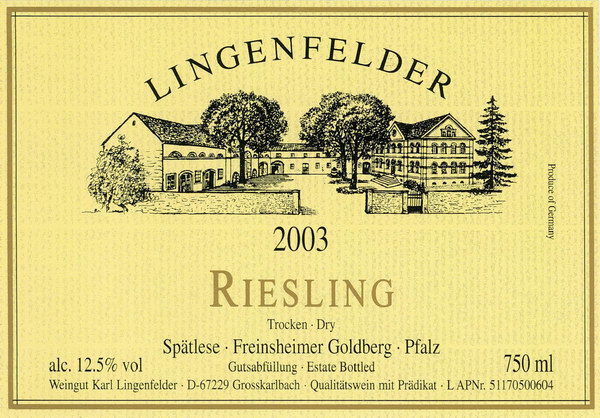
Label dry German Riesling spatlese
The share of Germany accounts for two-thirds of all the vineyards involved in the Riesling. The longest tradition of growing Riesling belongs to growers in the Rheingau and the Moselle. The most important of this is grown in Germany varieties grow in all areas of cultivation. In the Rheingau Riesling occupies over three quarters of all vineyards. Along with the region the most important producers of Riesling are the Mosel-Saar-Ruwer, Pfalz, württemberg, Rheinhessen, Baden and Nahe.
Riesling is a grape, maturation which takes place slowly and continues until November. Therefore, the most comfortably he feels in the Northern wine regions where he has the opportunity to catch the last warm rays of the autumn sun. The optimal conditions for it exist on the steep tiers along the rivers, providing him with a sufficient amount of heat.
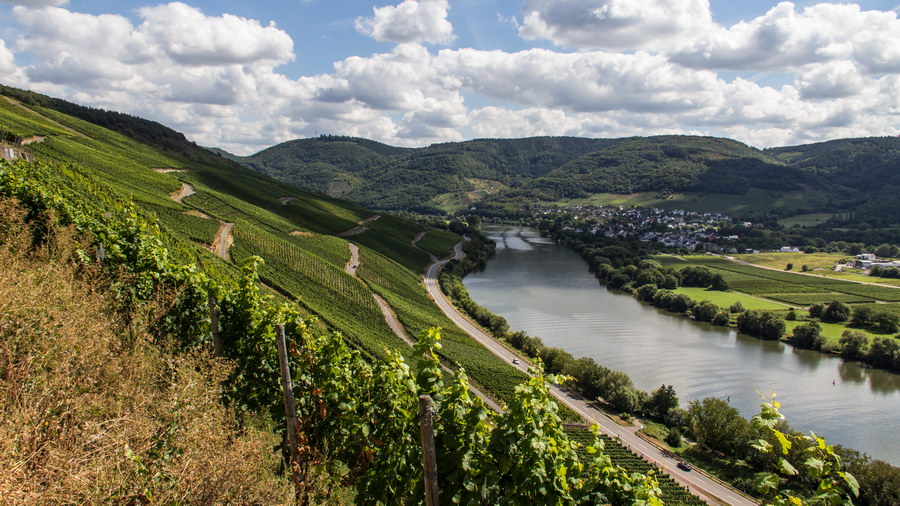
German vineyards Riesling
Dense spreading form clusters and later compared with other varieties, ripening, Riesling is exposed to the risk of defeat of undesirable rot and mold in the event of rains during ripening period.
Unfamiliar with the wine people can surprise you here the word “undesirable”. However, if successful a ripe berry left on the vine, and exposed to short-term exposure to moisture, it may develop the so-called “noble rot” fungus Botrytis cinerea. If he caught the vine just kidding, it is – malevolent grey rot, spoiling the harvest. But at the ripe bunches it can produce absolutely fabulous effect.
Affected by noble rot berry significantly loses moisture, resulting in increased concentration of sugars and aromatic substances. And the livelihoods of the mold enriches the berry substances that develop in the wine a rich exotic bouquet.
The taste and aroma of wines from Riesling
There are wines from Riesling all classes and any flavor directions. The “typical” Riesling has a pale yellow color with a tendency to greenish, with floral and Apple nuances in the flavor and with a noticeable acidity on the palate. Natural elevated levels of tartaric acid does not prevent this wine to retain great flavor balance, due to the relatively high level of residual sugar. The Rieslings grown in slate soils, stands a mineral note.
The main aromatic portrait of wines from Riesling include:
– The aromas of the variety: floral (white flowers, rose petals), herbaceous (grass), fruity (green Apple, grapefruit, pear, peach, apricot), sometimes with notes of tropical fruits (in warmer regions)
– Aromas of fermentation and aging: flint, metal, rubber, oil.
Aromas of oil, rubber, kerosene, tar, deserve special attention. These aromas develop in aged Rieslings, and really appreciated their fans, but can lead to confusion and cause rejection of untrained tasters.
In a well-folded bouquet such specific notes harmoniously surrounded by other colors and cause more interest than hostility: to define them as “oil” or “rubber” or “gudanova” is often possible only with the tip a sommelier, but do not agree with this definition after tips it will be difficult – they are so distinctive.
In the German language, these tones can be denoted by a special term Firn (literally – last year’s snow) that describes the characteristic notes of aging white German wines, and which is devoid of the negative associations that give rise to the description “oil” colors.
For the extravagant petroleum diesel aroma in wine is responsible norisoprenoids 1,1,6-trimethyl-1,2-dihydronaphthalene (TDN). This substance is missing from the berries and is formed in the process of aging, usually not earlier than after three years. If You are ready with the drink Rieslings are very young. …Or a very seasoned, as with age (more age), this tone is weakened.
But of aged Rieslings, this tone varies in intensity as the quantity of the precursors (starting compounds) for its formation depends on several significant factors.
The development of “oil notes” in wine contribute to:
- a high degree of ripeness (for example, the practice of late harvest)
- prolonged insolation
- the lack of moisture
- warm soils (gravel, etc.)
source
It is noteworthy that the same factors are characteristic of the German production of high-end wines capable of long aging. It turns out that the “oil ton” – a sign of aristocracy of German Riesling, as the probability of its occurrence in a simple and cheap wines is much lower. However, this rule does not work against Rieslings from the New world, as part of the listed conditions is just a climatic norm.
Opposition Influential winemaker from the Rhone Valley (France) Michel chapoutier, a supporter of biodynamism, believes that the oil tone in the wine – that’s his Vice. “Absurd – to consider the historical defects in wine part of his character,” he says. According to Mr. Chapoutier, petrol notes is the result of insufficiently careful pressing, destroying the capillary structure of the berries and leading to the emergence of substances responsible for the smell.
source
Noble-sweet wines of the type “beerenauslese” or “eiswein” are among the most expensive of German wines in the world. Dry and semi-dry Rieslings especially well with braised sea and river fish, boiled meat with light sauce and small poultry.
Pseudo-Rieslings, clones, hybrids
Italian Riesling, Welschriesling aka (Welschriesling) – no Riesling.
This technical white grape variety, not having family ties with a real German Riesling.
Welsch in the old German means “foreign” (meaning, mainly, Italian and French). Among the versions of origin there is speculation that he was originally from champagne. It is cultivated in Italy, Romania, Slovakia, Croatia, Hungary (it has a), of the Czech Republic.
Grey Riesling – known in California as Gray Riesling – not a Riesling.
In fact, this is the sort of trousseau Gris (Trousseau Gris) from East of France, a white mutation of the red varieties trousseau (aka Bastardo). In France it is found in the Jura region.
Missouri Riesling (Riesling Missouri) isn’t even a vinifera family. It is the result of crossing of the local (American) progeny of Vitis riparia and Vitis labrusca. Some time was believed to be lost during prohibition. However, in 2013, Westphalia Vineyards has released release of wine from this variety under the name “Renaissance”, announcing the revival of the lost clone.
Emerald Riesling, emerald (Emerald Riesling) – the result of crossing original white Riesling variety muscatel produced by the University of California, Davis, as an adaptation of Riesling for a warm climate. In addition to California, is actively cultivated in Israel.
Red Riesling (Roter Riesling) – red rare hybrid of the white Riesling. Despite the red hue of the skin, red, Riesling belongs to white varieties (like Gewurztraminer)
Black Riesling, sarcasming (Schwarzriesling) – alternative name for Pinot Meunier – “the youngest” of the three varieties of “champagne blend”